Cyberattacks can develop quickly and often occur outside normal working hours. Organisations may have security tools capable of generating alerts, but lack the time, specialist expertise, or internal resources required to investigate every warning and respond effectively.
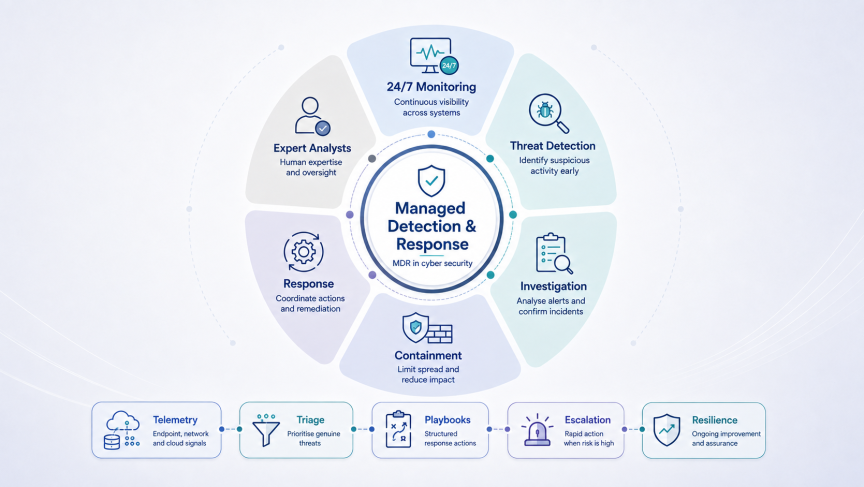
Managed Detection and Response, commonly abbreviated to MDR, addresses this problem by combining security technology with human analysis, threat hunting, investigation, and incident response.
Rather than providing another monitoring tool for an internal team to manage, MDR services give organisations access to an external security capability that actively reviews suspicious activity and helps contain genuine threats.
This article explains what MDR is, how managed detection and response services operate, the benefits they provide, and how MDR differs from a security operations centre, XDR, EDR, SIEM, and traditional managed security services.
What Does MDR Mean?
The MDR meaning is Managed Detection and Response.
MDR is a cyber security service that monitors an organisation’s technology environment, identifies suspicious activity, investigates potential incidents, and supports or performs response actions.
The service normally combines:
- Security technology
- Automated analytics
- Threat intelligence
- Security analysts
- Threat hunters
- Incident responders
- Defined response procedures
Microsoft describes MDR as an outsourced service that supports organisations with threat hunting and response while extending the capabilities of internal security teams. IBM similarly defines MDR as a round-the-clock service that monitors, detects, and responds to cyber threats in real time.
The exact scope varies between providers. Some services focus mainly on endpoints, while others monitor endpoints, networks, identities, email, cloud platforms, and applications.
The level of response also differs. One provider may offer advice and notify the customer, while another may be authorised to isolate devices, disable accounts, block malicious activity, and remove threats directly.
What Is MDR in Cyber Security?
MDR in cyber security is a managed operational capability rather than one individual product.
An organisation may already own endpoint detection, network monitoring, cloud security, or security information and event management tools. MDR adds the people and processes required to operate those technologies, investigate alerts, and take action.
A typical MDR service provides:
- Continuous security monitoring
- Alert validation and prioritisation
- Proactive threat hunting
- Incident investigation
- Threat containment
- Remediation guidance
- Threat intelligence
- Security reporting
- Control-improvement recommendations
MDR is intended to identify threats that have bypassed preventative controls or have not generated an obvious high-priority alert.
It should therefore complement firewalls, secure configuration, patch management, identity controls, endpoint protection, employee awareness, and other preventative measures. It is not a replacement for a wider cyber security programme.
Why Do Organisations Use MDR Services?
Modern security environments generate large volumes of information from endpoints, identities, cloud services, networks, applications, and email platforms.
Security teams may struggle to determine which events represent genuine attacks and which are routine or harmless activity.
Organisations commonly adopt MDR to address several challenges.
Limited Internal Capacity
Maintaining a fully staffed detection and response capability requires analysts, threat hunters, incident responders, engineering support, management, and suitable technology.
MDR provides access to specialist resources without requiring the organisation to build the entire function internally.
Alert Fatigue
Security platforms can generate significant numbers of alerts.
MDR analysts review, correlate, and prioritise this activity so that the organisation can focus on incidents that present meaningful risk.
Sophisticated Threats
Some attackers avoid obvious malware and use legitimate credentials, trusted applications, remote administration tools, or fileless techniques.
Human-led threat hunting can identify unusual patterns that a single automated control may not recognise.
Round-the-Clock Coverage
Attacks can occur at any time.
Many MDR providers offer 24-hour monitoring and response, reducing the likelihood that serious activity will remain unreviewed overnight, during weekends, or on public holidays.
Complex Technology Environments
Organisations increasingly operate across cloud platforms, remote devices, software-as-a-service products, identities, and traditional networks.
MDR can provide a more coordinated view across these environments, depending on the integrations and service scope.
How Does Managed Detection and Response Work?
Although provider methodologies differ, most managed detection and response services follow a similar operational workflow.
1. Collect and Correlate Security Data
The MDR provider connects to relevant security systems and data sources.
These may include:
- Endpoint detection tools
- Identity platforms
- Cloud environments
- Email-security systems
- Firewalls
- Network-security tools
- SIEM platforms
- Business applications
The provider uses this information to identify relationships between events that might appear harmless when reviewed separately.
2. Prioritise Alerts
Automation and human analysis are used to separate likely threats from false positives and low-risk activity.
The provider considers factors such as:
- Affected assets
- User behaviour
- Known attacker techniques
- Threat intelligence
- Data sensitivity
- Privilege level
- Potential business impact
This triage process helps prevent internal teams from being overwhelmed by alerts that do not require urgent action.
3. Hunt for Hidden Threats
Threat hunting is a proactive search for activity that may not have triggered a conventional alert.
Analysts may investigate:
- Unusual account behaviour
- Suspicious administrative tools
- Lateral movement
- Persistence mechanisms
- Command-and-control traffic
- Abnormal data transfers
- Previously unidentified malware
Endpoint detection and response platforms commonly support threat hunting by collecting endpoint activity and allowing analysts to search for suspicious patterns and indicators.
4. Investigate the Incident
When suspicious activity is identified, analysts determine:
- What happened
- How the activity began
- Which users and systems are affected
- Whether the attacker remains active
- What information may have been accessed
- How far the attack has progressed
- Which response actions are required
A mature investigation should connect technical findings with business context so that the most important systems and risks receive priority.
5. Contain and Remediate the Threat
Depending on the agreement, the MDR provider may perform response actions directly or provide guided instructions to the customer.
Actions may include:
- Isolating a compromised endpoint
- Disabling a user account
- Blocking malicious domains or addresses
- Stopping harmful processes
- Removing malicious files
- Revoking active sessions
- Resetting credentials
- Eliminating persistence mechanisms
The UK National Cyber Security Centre recommends aligning security monitoring with incident-management processes so that organisations can detect, investigate, and respond to incidents effectively. Reliable logging, clearly defined responsibilities, and established response procedures are important parts of that capability.
6. Review and Improve
After containment, the provider may perform root-cause analysis and recommend improvements.
These may include:
- Updating detection rules
- Correcting insecure configurations
- Patching vulnerabilities
- Strengthening access controls
- Improving network segmentation
- Updating response procedures
- Providing additional staff training
Regular reporting should explain which incidents occurred, what actions were taken, and which risks require further attention.
Benefits of MDR Services
Faster Detection and Response
MDR provides analysts and response processes dedicated to reviewing threats.
This can reduce the time between suspicious activity beginning, being identified, and being contained.
Access to Security Expertise
Organisations gain access to analysts, threat hunters, and incident-response specialists who work across multiple customer environments and threat scenarios.
This can be valuable where an internal IT team has broad responsibilities but limited specialist detection and response experience.
Reduced Internal Workload
The provider assumes responsibility for activities such as:
- Alert monitoring
- Initial investigation
- Threat hunting
- Evidence gathering
- Incident prioritisation
- Response coordination
This allows internal personnel to focus on business-specific decisions, remediation, governance, and strategic security improvements.
Improved Use of Existing Tools
Security technology may be underused if internal teams do not have enough time or expertise to configure and monitor it properly.
An MDR provider can help organisations obtain greater value from endpoint, identity, cloud, network, and SIEM investments.
Predictable Service Model
MDR is commonly provided through a subscription or managed-service agreement.
This may offer more predictable costs than building a complete internal detection and response team, although value depends on the scope, quality, and pricing model of the service.
Support for Compliance and Assurance
MDR may support compliance by providing:
- Security monitoring
- Incident records
- Investigation evidence
- Response documentation
- Regular reports
- Control-performance information
For UK organisations, these capabilities can also support wider security and accountability obligations. Where personal data is involved, the UK GDPR requires organisations to implement appropriate technical and organisational measures to protect that data. Detection, monitoring and effective incident response can contribute to demonstrating how those security responsibilities are being managed.
However, using MDR does not automatically make an organisation compliant. The customer remains responsible for its legal, regulatory, contractual, and governance obligations.
MDR Compared With Other Security Models
Several security services and technologies overlap with MDR, but they are not interchangeable.
|
Model |
What It Is |
Main Distinction |
|
MDR |
Managed detection, investigation, hunting, and response service |
Combines technology with external human expertise |
|
SOC |
Security operations function operated internally or externally |
Broader function that may manage many security activities |
|
XDR |
Technology platform correlating data across multiple security domains |
Provides technology rather than a complete managed team |
|
EDR |
Technology monitoring and responding to activity on endpoints |
Focuses primarily on endpoint devices |
|
SIEM |
Platform collecting and analysing security logs |
Requires people and processes to investigate and respond |
| MSSP |
Provider offering a broad range of managed security services |
May focus more on management and alerting than active response |
MDR Versus SOC
A Security Operations Centre is a central function responsible for monitoring and responding to security activity.
A SOC may be operated internally, externally, or through a hybrid model. It can cover broader responsibilities than MDR, including security engineering, tool administration, governance support, and vulnerability management.
MDR is usually a defined outsourced detection and response service. It may operate as an extension of an existing SOC or provide core operational coverage where no internal SOC exists.
MDR Versus XDR
Extended Detection and Response is a technology platform that combines data from endpoints, identities, cloud workloads, networks, email, and other security domains.
MDR is a managed service. It may use XDR technology, but it also provides analysts, investigation processes, threat hunting, and response.
Microsoft distinguishes MDR as outsourced security operations and monitoring, while XDR is the technology used to detect and respond across multiple domains.
MDR Versus EDR
Endpoint Detection and Response monitors endpoint devices such as laptops, workstations, and servers.
EDR can identify suspicious behaviour, isolate devices, support investigations, and automate some response actions.
MDR may use EDR as one of its core technologies, but adds external analysts and may extend coverage beyond endpoints into identities, cloud services, email, and networks.
MDR Versus MSSP
A Managed Security Service Provider may operate firewalls, security tools, vulnerability services, compliance monitoring, and other security infrastructure.
Traditional MSSP services often focus on monitoring and notifying the customer. MDR places greater emphasis on active threat hunting, investigation, containment, and response.
However, provider terminology varies. Customers should evaluate the actual service rather than relying solely on the label. CrowdStrike similarly notes that response capabilities can vary significantly between MDR providers.
MDR Versus SIEM
A SIEM collects and analyses logs from multiple systems.
It can correlate events, generate alerts, support investigations, and retain security records. However, the platform still requires skilled personnel to configure detection rules, review alerts, investigate incidents, and coordinate response.
MDR may operate a SIEM on the customer’s behalf or integrate with an existing platform.
How to Choose an MDR Provider
The right provider should be selected according to the organisation’s risks, technology environment, and required level of response.
UK organisations should also establish clear contractual responsibilities for logging, incident notification, response, service levels, and access to relevant security information. These areas should be considered carefully when selecting and working with a managed security provider so that responsibilities between the provider and customer remain clear.
Confirm the Scope
Determine which environments are monitored:
- Endpoints
- Networks
- Cloud platforms
- Identities
- Applications
- Operational technology
Clarify Response Authority
Establish whether the provider can take direct action or only provide recommendations.
The agreement should specify which actions are pre-authorised and which require customer approval.
Review Service Levels
Evaluate commitments covering:
- Alert-review times
- Escalation
- Investigation
- Containment
- Communication
- Service availability
Assess Integrations
Confirm that the service can work with the organisation’s existing endpoint, cloud, identity, network, SIEM, and ticketing systems.
Examine Data Handling
Understand:
- Which information is collected
- Where it is processed and stored
- How long it is retained
- Which subcontractors are involved
- How access is controlled
- How data is deleted when the service ends
Evaluate Expertise and Reporting
The provider should demonstrate relevant threat-hunting and incident-response experience.
Reports should explain risks and actions clearly rather than presenting only technical alert volumes.
Measuring MDR Effectiveness
Useful measures may include:
- Mean time to detect
- Mean time to investigate
- Mean time to contain
- Response service-level performance
- False-positive rate
- Number of confirmed incidents
- Threat-hunting findings
- Recurring root causes
- Remediation completion
- Coverage across critical systems
Metrics should measure outcomes rather than activity alone. A large number of generated alerts does not necessarily indicate an effective service.
Shared Responsibilities and Limitations
MDR does not transfer all security responsibility to the provider.
The customer still needs to:
- Maintain secure configurations
- Apply security updates
- Control user access
- Protect backups
- Manage suppliers
- Train employees
- Approve business decisions
- Remediate underlying weaknesses
- Maintain incident and recovery plans
The division of responsibility should be defined clearly before the service begins.
An MDR provider may detect and contain an attack, but long-term improvement still depends on the organisation addressing the conditions that allowed the incident to occur.
Strengthening Detection and Response
Managed Detection and Response combines security technology with human expertise to provide monitoring, threat hunting, investigation, containment, and response. For organisations without sufficient internal detection capability, MDR can improve visibility, reduce alert fatigue, and support faster, better-informed responses to genuine threats.
The value of MDR depends on the service itself. Organisations should assess monitoring coverage, response authority, integrations, data handling, service levels, expertise, and reporting, while ensuring that responsibilities between the provider and customer are clearly defined. MDR should complement secure configuration, vulnerability management, identity controls, backups, incident planning, and remediation rather than replace them.
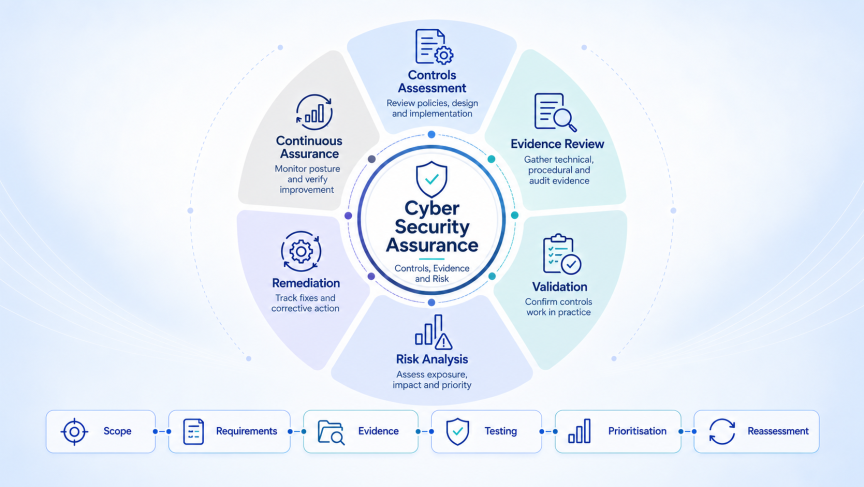
SeCore’s Security Assurance services help organisations assess security controls, identify gaps, measure risk, and prioritise remediation. By connecting MDR evidence with wider security assurance, organisations can turn day-to-day detection and response activity into clearer evidence of control effectiveness and stronger long-term resilience.