Modern organisations rely on external providers for cloud hosting, software, payroll, payment processing, logistics, professional services, and other essential functions. These relationships can reduce costs and provide specialist capabilities, but they also create risks that the organisation cannot control directly.
Third Party Risk Management, commonly shortened to TPRM, is the structured process used to identify, assess, control, and monitor those risks throughout a supplier relationship.
A strong TPRM framework helps an organisation understand which third parties it depends on, what information or systems they can access, how their failure could affect operations, and which safeguards are required.
This article explains what Third Party Risk Management is, the risks it addresses, and how organisations can establish an effective third party and vendor risk management programme.
What Is Third Party Risk Management?
Third Party Risk Management is the process of managing risks created by vendors, suppliers, contractors, service providers, business partners, and other external organisations.
It is sometimes referred to as:
- Vendor risk management
- Supplier risk management
- Third party vendor risk management
- Supply chain risk management
These terms overlap, although TPRM often covers a wider range of relationships and risks than a traditional supplier review.
A third party may:
- Process personal or commercially sensitive information
- Connect to internal systems
- Host critical applications
- Supply software or equipment
- Deliver an essential operational service
- Act on the organisation’s behalf
- Depend on further subcontractors
Those subcontractors are often described as fourth parties or nth parties. The organisation may not have a direct contract with them, but their failure or compromise can still affect the service it receives.
NIST defines cyber supply chain risk management as identifying, assessing, and mitigating risks across interconnected technology product and service supply chains throughout the system lifecycle. This reflects a central TPRM principle: outsourcing a service does not remove the associated risk.
Why Is TPRM Important?
Third parties can expand an organisation’s attack surface and create operational dependencies that are difficult to see or control.
A supplier with access to customer data, cloud infrastructure, administrative credentials, or internal networks may become an indirect route into the organisation. A service outage or financial failure at a critical provider can also interrupt business operations without a cyberattack taking place.
The National Cyber Security Centre states that organisations remain accountable for protecting essential functions when third-party services are used. It recommends understanding supplier dependencies, including subcontractors, placing suitable security obligations in contracts, and preparing for supply chain incidents.
Effective TPRM supports:
- Cyber security and data protection
- Operational resilience
- Regulatory compliance
- Business continuity
- Customer and stakeholder trust
- More informed procurement decisions
Common Types of Third-Party Risk
A third party risk assessment should consider more than cyber security alone.
Cyber Security and Privacy Risk
A provider may expose information or systems through insecure software, weak access controls, poor configuration, insufficient monitoring, or a security breach.
The potential impact increases when the provider stores sensitive data, holds privileged access, or connects directly to important systems.
Operational Risk
A service outage, staffing failure, supply delay, or loss of a critical platform may prevent the organisation from operating normally.
The assessment should consider the importance of the service, recovery arrangements, alternative providers, and the effect of prolonged disruption.
Compliance and Legal Risk
A third party may fail to meet data protection, contractual, geographical, or sector-specific requirements.
The contracting organisation may remain accountable for its obligations even where the relevant activity has been outsourced.
Financial Risk
A supplier’s financial instability, insolvency, unexpected price changes, or inability to invest in its service may affect continuity and create significant replacement costs.
Reputational and Ethical Risk
A supplier’s security incident, misconduct, labour practices, environmental record, or regulatory failure may damage the organisation’s reputation and customer relationships.
Strategic and Geopolitical Risk
A relationship may conflict with long-term business objectives or create exposure to sanctions, political instability, trade restrictions, or excessive dependence on one provider or region.
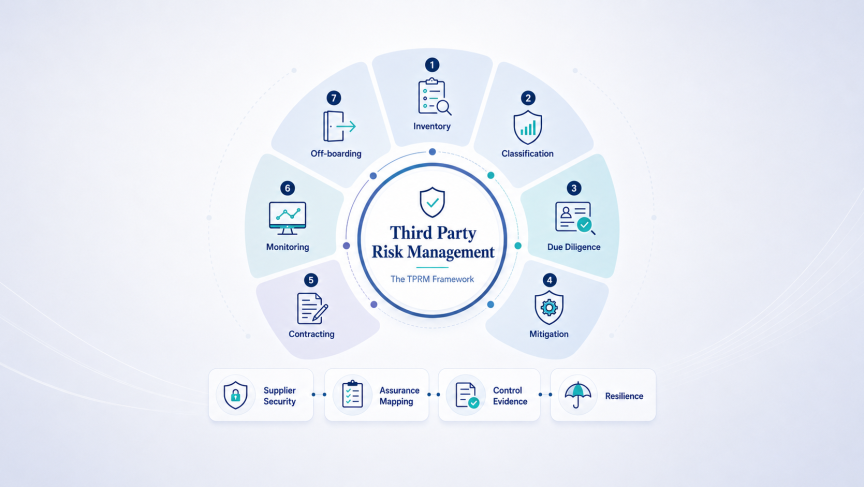
The TPRM Framework and Lifecycle
An effective TPRM programme should cover the complete relationship, from initial identification to secure termination.
1. Identify and Inventory Third Parties
The organisation should maintain a central inventory of vendors, suppliers, contractors, and partners.
The inventory should record:
- The service provided
- The internal relationship owner
- The information accessed
- System connections
- Contract and renewal dates
- Business criticality
- Relevant subcontractors
- Assessment status
An incomplete inventory creates unmanaged risk because the organisation cannot assess relationships it does not know exist.
2. Classify Inherent Risk
Not every supplier requires the same level of scrutiny.
Third parties should be classified according to factors such as:
- Access to sensitive data
- Access to systems or networks
- Importance of the service
- Potential operational impact
- Regulatory relevance
- Ease of replacement
- Geographic exposure
A critical cloud provider or payroll processor should normally undergo more detailed due diligence than a supplier with no access to confidential information or technology.
A common model places suppliers into high, medium, and low-risk tiers. The assessment depth and monitoring frequency can then be matched to the risk level.
3. Conduct Due Diligence and Risk Assessment
A vendor risk assessment determines whether the provider’s controls and resilience are appropriate for the proposed relationship.
Evidence may include:
- Security questionnaires
- ISO/IEC 27001 certificates
- SOC 2 reports
- Penetration test summaries
- Data protection documentation
- Business continuity plans
- Financial information
- Insurance records
- Incident history
- Sanctions and adverse-media checks
Questionnaires should be proportionate and supported by evidence. A completed form does not necessarily prove that controls operate effectively.
NIST’s due diligence guidance describes supplier assessment as researching relevant information so that informed acquisition and risk decisions can be made.
4. Decide, Mitigate, and Approve Risk
Identified weaknesses should be compared with the organisation’s risk appetite.
Possible responses include:
- Requiring remediation before onboarding
- Introducing compensating controls
- Limiting access or data sharing
- Selecting another provider
- Accepting a documented residual risk
- Rejecting the relationship
Risk acceptance should have a clear business justification, an accountable approver, and a defined review date.
5. Establish Contractual Controls and Onboard Securely
Contracts should convert security expectations into enforceable obligations.
Relevant provisions may cover:
- Data protection and confidentiality
- Minimum security controls
- Access restrictions
- Incident notification
- Audit and assurance rights
- Subcontractor management
- Service levels
- Business continuity
- Data location
- Vulnerability management
- Data return or deletion
- Exit support
Onboarding should provide only the access required to deliver the service. Accounts, permissions, integrations, and data-sharing arrangements should be approved, recorded, and monitored.
6. Monitor the Relationship
Risk can change after onboarding.
A supplier may introduce new subcontractors, change ownership, suffer an incident, move information to another location, alter its service, or allow certifications to expire.
Ongoing monitoring may include:
- Periodic reassessment
- Certification and control reviews
- Service-performance monitoring
- Security alerts
- Incident tracking
- Adverse-media screening
- Contract reviews
- Access recertification
Monitoring should be proportionate. Critical suppliers require more frequent and detailed review than low-risk providers.
The NCSC recommends treating third-party risk information as a living record that is reviewed throughout the service lifecycle rather than only before procurement.
7. Off-board Securely
When a relationship ends, the organisation should:
- Revoke accounts and privileged access
- Disable credentials, keys, and integrations
- Recover equipment and information
- Confirm data return or deletion
- Retain required evidence
- Update the supplier inventory
- Transfer the service safely where necessary
Poor off-boarding can leave active accounts, retained data, forgotten integrations, and unsupported dependencies behind.
TPRM Governance and Best Practices
An effective vendor risk management programme requires cooperation across security, procurement, legal, privacy, finance, operations, and business teams.
Define Ownership
The organisation should establish who owns the TPRM programme, who performs assessments, who approves suppliers, and who monitors remediation.
Each third party should also have an internal business owner responsible for the relationship.
Apply a Proportionate Approach
The same assessment should not be applied to every supplier.
Risk tiering allows the organisation to concentrate detailed reviews, monitoring, and remediation on the relationships capable of causing the greatest harm.
Use Consistent Standards
Standardised assessment criteria improve consistency and comparability.
Organisations may use recognised approaches such as:
- NIST Cybersecurity Framework 2.0
- NIST SP 800-161
- ISO/IEC 27001
- SOC 2
- Standardised supplier questionnaires
NIST Cybersecurity Framework 2.0 includes a dedicated supply chain risk category that organisations can use to establish a capability and communicate requirements to suppliers.
Plan for Third-Party Incidents
Incident response plans should address supplier events before they occur.
They should define:
- Escalation contacts
- Communication routes
- Evidence-sharing expectations
- Containment responsibilities
- Service-continuity arrangements
- Customer and regulatory notification responsibilities
Assess Concentration and Fourth-Party Risk
Several business services may depend on the same cloud platform, data centre, software component, or subcontractor.
Mapping these dependencies helps identify situations in which one provider failure could affect several systems or business functions simultaneously.
Third Party Risk Management Software
Third party risk management software can reduce administrative work and improve oversight across large supplier portfolios.
Common capabilities include:
- Vendor inventories
- Automated intake and risk tiering
- Security questionnaires
- Risk scoring
- Evidence collection
- Remediation workflows
- Continuous monitoring
- Contract and renewal alerts
- Dashboards and reporting
- Off-boarding workflows
Vendor risk management software can improve efficiency, but it does not replace professional judgement.
Automated ratings may identify external warning signs, but they cannot provide a complete view of internal controls, contractual exposure, operational importance, or the organisation’s specific risk appetite.
The software should support the organisation’s TPRM framework rather than forcing every supplier through the same generic assessment.
Regulatory Expectations and the Future of TPRM
Regulators increasingly expect organisations to understand and control external dependencies.
NIS2 includes supply chain security among its cyber security risk-management requirements for in-scope EU entities.
The Digital Operational Resilience Act requires in-scope financial entities to manage ICT third-party risk as part of their wider ICT risk framework. It also makes clear that financial entities remain responsible for compliance where ICT services are outsourced.
The EU AI Act creates responsibilities across the AI value chain, including information-sharing and oversight obligations for certain providers, deployers, and third parties. Organisations procuring AI services may therefore need more detailed assurance concerning documentation, data use, human oversight, and responsibilities.
TPRM programmes are consequently moving towards:
- Greater visibility of fourth-party dependencies
- Continuous rather than annual monitoring
- Stronger operational-resilience planning
- More structured supplier incident response
- AI-assisted assessment and evidence review
- Closer integration with procurement and enterprise risk
Automation can accelerate assessments, but accountability remains with the organisation.
Managing Third Party Risk Effectively
Third Party Risk Management is the structured process of identifying, assessing, mitigating, and monitoring risks created by vendors, suppliers, contractors, and service providers.
A strong TPRM framework covers the complete relationship lifecycle: inventory, risk classification, due diligence, mitigation, contracting, monitoring, and off-boarding.
The objective is not to eliminate every third-party risk. It is to understand external dependencies, apply proportionate controls, and make informed decisions about which risks can be accepted.
SeCore helps organisations assess supplier security, map assurance requirements, monitor control evidence and prioritise remediation. By connecting third-party risk assessment with wider Security Assurance, organisations can improve resilience across their extended business ecosystem.