Artificial intelligence is changing how cyber threats are created, detected, investigated, and contained. Security teams are using AI to analyse large volumes of activity, identify suspicious behaviour, prioritise vulnerabilities, and automate repetitive work. Cybercriminals are using the same technology to improve phishing, fraud, reconnaissance, malware development, and social engineering.
The relationship between AI and cybersecurity is therefore not one-sided. Artificial intelligence can strengthen organisational protection, but it can also make established attack techniques faster, more convincing, and more accessible.
The United Kingdom National Cyber Security Centre assesses that AI will continue to make parts of cyber intrusion more effective and efficient. It expects this to increase the frequency and intensity of cyber threats and expand access to AI-enabled capabilities among state and non-state actors.
This article explains the role of AI in cyber security, how attackers and defenders use it, the benefits and limitations of AI-assisted security, and the controls organisations need to adopt it responsibly.
What Is Artificial Intelligence?
Artificial intelligence refers to computer systems that perform tasks commonly associated with human intelligence, including recognising patterns, interpreting language, making predictions, generating content, and supporting decisions.
Several branches of AI are particularly relevant to cyber security:
- Machine learning uses algorithms that learn from data and identify patterns without relying entirely on fixed rules
- Deep learning uses multilayer neural networks to analyse complex data such as network traffic, files, images, and behavioural signals
- Natural language processing allows people to interact with systems using ordinary language
- Generative AI creates new text, software code, images, audio, video, and other content
- AI agents can complete defined tasks with a degree of autonomy
These technologies can help defenders process security data at a speed and scale that would be difficult for a human team to achieve manually.
What Is AI in Cyber Security?
AI in cyber security is the application of artificial intelligence and machine learning to protect networks, systems, applications, identities, devices, and data.
Security platforms can use AI to analyse information from:
- Security logs
- Network traffic
- Endpoints
- Cloud services
- Identity platforms
- Email systems
- Applications
- Threat intelligence
The system can then identify unusual activity, connect related events, prioritise incidents, recommend actions, and automate approved response processes.
The use of AI in cyber security does not remove the need for traditional controls or professional judgement. Its main value is improving the speed, scale, and consistency with which security information can be analysed.
AI for Cybersecurity and AI Security
It is important to distinguish between using AI for cybersecurity and securing AI itself.
AI for Cybersecurity
AI for cybersecurity means using artificial intelligence to improve an organisation’s wider security posture.
Examples include:
- Detecting malicious files
- Analysing network traffic
- Identifying unusual account activity
- Prioritising vulnerabilities
- Supporting incident response
AI Security
AI security focuses on protecting AI models, data, applications, and integrations from attack or misuse.
Relevant threats include:
- Data poisoning
- Prompt injection
- Model theft
- Adversarial inputs
- Sensitive data leakage
- Unauthorised model access
- Manipulation of generated outputs
NIST identifies evasion, poisoning, privacy, and misuse attacks among the principal categories of adversarial machine-learning risk. It also notes that existing mitigation techniques have limitations.
AI for cybersecurity is therefore about AI protecting the organisation, while AI security concerns the organisation protecting its AI. A mature security programme needs to address both.
How Cybercriminals Use Artificial Intelligence
AI does not automatically turn an inexperienced individual into a sophisticated attacker. However, it can reduce the time, effort, and specialist knowledge required to complete parts of an attack.
The most immediate concern is not a completely autonomous cyberattack. It is the ability of AI to make familiar techniques faster, cheaper, and easier to scale.
Phishing and Social Engineering
Generative AI can help criminals create more convincing and personalised:
- Phishing emails
- Fraudulent text messages
- Business email compromise messages
- Voice-phishing scripts
- Impersonation messages
- Fraudulent websites
Attackers can use publicly available information about an organisation, employee, customer, or supplier to produce messages that appear relevant and credible. AI can also remove many of the spelling and grammatical errors that previously helped users identify scams.
Deepfake Impersonation
Deepfake technology can generate or manipulate voices, images, and video to imitate trusted individuals.
A fraudulent voice message or video call may be used to authorise a payment, request confidential information, change bank details, or persuade an employee to bypass normal controls.
Organisations should therefore require independent verification for unusual financial instructions, account changes, credential requests, and urgent demands from senior personnel.
Credential and Malware Attacks
AI can assist attackers in analysing leaked credentials, identifying password patterns, automating password guessing, modifying malicious scripts, and processing stolen information.
The NCSC expects AI to enhance reconnaissance, vulnerability research, social engineering, basic malware generation, and the exploitation of known vulnerabilities. It does not expect fully automated, end-to-end advanced cyberattacks to become the norm in the immediate future, meaning that skilled attackers will remain involved.
AI-Powered Fraud
Criminals can use AI-generated websites, profiles, endorsements, images, and videos to make scams appear legitimate.
Examples include:
- Fake investment platforms
- Cloned company websites
- Fraudulent customer reviews
- Impersonated advisers
- False endorsements
The technology may be new, but many warning signs remain familiar: guaranteed returns, pressure to act quickly, unsolicited contact, and resistance to independent verification.
Key Applications of AI in Cyber Security
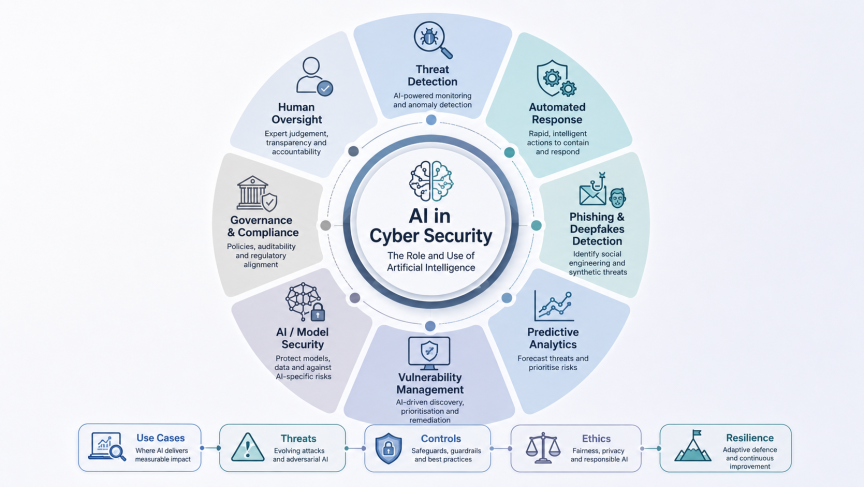
The application of AI in cyber security extends across threat detection, network monitoring, identity protection, email security, data protection, vulnerability management, and security operations.
Threat Detection and Incident Response
AI systems can learn normal patterns of behaviour across users, devices, applications, cloud workloads, and network connections. They can then flag activity that differs significantly from the expected baseline.
For example, an unfamiliar login may not justify an urgent response by itself. However, the same login followed by an excessive data download, an attempt to alter security settings, and access to sensitive systems may indicate account compromise.
AI can also correlate alerts across identity platforms, endpoints, email, applications, cloud services, and networks. This helps security teams recognise when several low-level events form part of the same attack.
During an investigation, AI can:
- Summarise the incident
- Identify affected users and systems
- Retrieve relevant threat intelligence
- Recommend investigation steps
- Prioritise the most serious alerts
- Produce an initial timeline
These capabilities reduce the time analysts spend gathering information, allowing them to focus on judgement, containment, and recovery.
AI in Network Security
AI in network security helps organisations monitor environments in which traffic and device behaviour change continually.
AI-driven systems can establish normal network patterns and detect activity that may indicate:
- Malware communication
- Data exfiltration
- Lateral movement
- Unauthorised devices
- Command-and-control traffic
- Compromised Internet of Things devices
AI can also strengthen network detection and response, intrusion prevention, next-generation firewalls, and security policy management.
Automated recommendations should still be reviewed before implementation. An incorrect network policy could interrupt legitimate operations or create unintended access.
Identity and Access Management
AI-enabled identity systems can assess the risk of each sign-in or access request using information such as:
- Location
- Device condition
- Access history
- User behaviour
- Network context
- Resource sensitivity
- Biometric or interaction patterns
Low-risk activity may continue normally, while higher-risk behaviour may trigger multi-factor authentication, additional identity verification, a password reset, session termination, or access denial.
AI can also help identify credential stuffing, brute-force attacks, impossible travel, compromised accounts, and unusual privilege escalation.
Email, Data, Endpoint, and Cloud Security
AI can examine email content, sender behaviour, attachments, links, and domain information to identify phishing attempts. It may detect lookalike domains, impersonated senders, malicious attachments, and unusual payment requests.
For data security, AI can help organisations locate sensitive information, apply classification labels, detect excessive access, identify shadow data, and block suspicious transfers.
On endpoints, AI can identify malware behaviour, suspicious processes, outdated software, and privilege misuse. Where appropriate controls and approvals are in place, a compromised device may be isolated automatically.
In cloud environments, AI can correlate signals across identities, applications, storage, workloads, and configurations to identify exposed data, excessive permissions, misconfigurations, and suspicious administrative activity.
Vulnerability Management and Penetration Testing
AI can help prioritise vulnerabilities by combining technical severity with practical context, including:
- Asset importance
- Internet exposure
- Exploit availability
- Active threat intelligence
- Data sensitivity
- Existing controls
This allows teams to focus on weaknesses that present the greatest real-world risk rather than treating every finding as equally urgent.
AI can also support penetration testing by automating reconnaissance, generating test cases, identifying possible attack paths, and analysing system responses.
Automated tools should augment rather than replace skilled penetration testers. Human testers provide creativity, contextual understanding, ethical judgement, and the ability to identify complex weaknesses that automated systems may miss.
Security Operations and AI Agents
Security information and event management and extended detection and response platforms increasingly use AI to aggregate and correlate signals across an organisation.
AI can help security operations teams:
- Reduce duplicate alerts
- Group related activity
- Prioritise incidents
- Enrich findings with threat intelligence
- Generate investigation queries
- Recommend response actions
- Support proactive threat hunting
AI-powered agents can also complete defined tasks, such as triaging phishing alerts, analysing data-loss-prevention events, or reviewing identity risks.
Greater autonomy makes approval controls, audit trails, permission boundaries, and human oversight increasingly important.
Benefits of Artificial Intelligence in Cyber Security
The benefits of artificial intelligence in cyber security depend on the quality of the data, implementation, governance, and human oversight.
Speed and Scale
AI can process security information at a volume and speed that would be impossible for a human team to match manually.
This is particularly valuable for organisations managing:
- Large numbers of endpoints
- Multiple cloud environments
- Remote users
- Complex supply chains
- High alert volumes
Reduced Manual Work
AI can automate repetitive activities such as initial alert classification, log analysis, alert enrichment, incident summarisation, and report preparation.
This allows security professionals to devote more time to complex investigations, threat hunting, security architecture, risk analysis, and control improvement.
Better Prioritisation
AI can combine technical severity with business context.
A severe vulnerability on an isolated test server may be less urgent than a moderately rated weakness on an internet-facing system containing sensitive customer information. AI-assisted analysis can help teams allocate limited resources more effectively.
Improved Pattern Detection
AI can identify relationships across large data sets and detect subtle behaviour that may not activate a traditional signature-based control.
This can support the detection of new or previously unrecognised attack patterns. However, AI cannot guarantee that every zero-day attack or unknown threat will be identified.
Greater Process Consistency
Automation can help ensure alerts are enriched, assessed, documented, and routed through established workflows consistently.
However, automating a weak or poorly governed process will reproduce its weaknesses at greater speed. The underlying process must be effective before it is automated.
Risks and Limitations of AI-Assisted Security
AI is not automatically accurate, objective, or secure.
False Positives and False Negatives
AI systems may classify legitimate activity as malicious or fail to recognise a real threat.
Excessive false positives create alert fatigue, while false negatives can create unjustified confidence. Models require testing, monitoring, tuning, and human review.
Hallucinations
Generative AI can produce information that appears credible but is inaccurate, incomplete, or unsupported.
High-impact security actions should not be taken solely because an AI system recommended them. Appropriate validation and approval should remain in place.
Poor Data Quality
AI performance depends heavily on the information it receives.
Incomplete logs, inaccurate asset inventories, incorrect labels, and fragmented systems can produce unreliable findings. Improving data quality is often a prerequisite for successful AI adoption.
Model Manipulation
Attackers may attempt to poison training data, manipulate prompts, bypass safeguards, or force a model to generate misleading results.
AI models and their integrations should be treated as part of the attack surface and secured accordingly.
Privacy and Confidentiality
AI platforms may process significant quantities of sensitive information.
Organisations need to understand:
- What data enters the system
- Where it is processed
- How long it is retained
- Whether it is used for model training
- Which third parties can access it
- How prompts and outputs are logged
Over-reliance on Automation
Human professionals understand the organisation’s systems, operational priorities, legal responsibilities, and risk appetite.
AI can support judgement, but it cannot assume accountability. Qualified people must remain involved in decisions that could disrupt services, restrict access, affect employees, expose data, or create legal consequences.
How Organisations Should Prepare
Organisations should adopt AI in cyber security through a controlled and risk-based process.
Start With a Defined Use Case
Begin with a clear security problem, such as phishing triage, vulnerability prioritisation, identity-risk analysis, data classification, or incident summarisation.
Establish Governance
Define approved uses, accountability, data restrictions, human approval requirements, testing standards, monitoring arrangements, and incident procedures.
Secure and Test the System
AI platforms should be protected through access control, encryption, logging, vulnerability management, secure integration, and incident-response planning.
Before deployment, organisations should evaluate accuracy, false-result rates, privacy risks, resistance to manipulation, operational impact, and recovery procedures.
Maintain Human Oversight and Security Fundamentals
AI cannot compensate for weak identity controls, incomplete asset inventories, insecure email, unpatched systems, poor backups, or untested response plans.
The most effective AI-enabled security programme still depends on disciplined fundamentals and qualified human oversight.
The Future of AI and Cybersecurity
The future of AI and cybersecurity is likely to involve deeper automation, more capable agents, natural-language investigation, and stronger integration between security tools.
Generative AI will increasingly help teams produce:
- Incident summaries
- Investigation timelines
- Remediation instructions
- Threat-hunting queries
- Executive reports
AI agents will move beyond passive recommendations and complete more approved operational tasks. This will increase the importance of transparent reasoning, permission boundaries, human approval, audit trails, and emergency controls.
Organisations will also need professionals who combine cyber security expertise with knowledge of AI security, model governance, data protection, and adversarial machine learning.
An Analogy for AI in Cyber Security
Think of an organisation’s cyber security environment as a large castle facing a fast-moving army.
Traditional security relies on human guards watching the walls, checking known entry points, and reporting suspicious activity. The guards are knowledgeable, but they can observe only a limited area at one time.
AI adds always-on sentries and predictive radar. These systems can monitor distant movement, identify unusual patterns, connect events across different parts of the castle, and prioritise the threats that appear most dangerous.
Automated controls may close a gate, restrict access, or alert the appropriate team. However, human commanders are still required to decide whether the warning is credible, understand the attacker’s objective, and select the correct response.
AI strengthens the defence, but human judgement remains responsible for directing it.
Using AI Securely and Responsibly
The role of AI in cyber security is expanding rapidly. Artificial intelligence can help organisations analyse data at scale, detect suspicious behaviour, protect identities, prioritise vulnerabilities, investigate incidents, and automate routine security operations.
At the same time, attackers are using AI to improve phishing, fraud, social engineering, reconnaissance, malware development, and synthetic impersonation.
Organisations must therefore address both sides of the issue: using AI to strengthen cyber defence while protecting AI systems against manipulation, misuse, and data exposure.
Successful adoption requires reliable data, strong security fundamentals, clear governance, secure integration, continuous testing, and qualified human oversight.
SeCore helps organisations assess their security posture, identify control gaps, measure risk, and prioritise security improvements. By combining structured assurance with the responsible adoption of emerging technology, organisations can strengthen cyber resilience without losing accountability or control.