Web applications are central to how organisations deliver services, communicate with customers, process information and support internal operations. Customer portals, e-commerce platforms, cloud-based applications, online payment systems and business software can all expose valuable information and functionality to the internet.
As applications become more complex, the number of potential weaknesses can also increase. Authentication systems, application programming interfaces, third-party components, cloud services, databases and business logic can all create attack paths if they are not designed, configured or maintained securely.
Web application penetration testing is an authorised security assessment that simulates realistic attacks against a web application to identify and validate vulnerabilities before they can be exploited by malicious actors.
Unlike automated vulnerability scanning alone, penetration testing combines security tools with manual investigation, technical judgement and controlled exploitation. This allows testers to determine not only whether a weakness exists, but also whether it can be exploited and what impact successful exploitation could have.
This article explains what web application penetration testing is, how the testing methodology works, the vulnerabilities commonly assessed and how organisations can use penetration testing as part of a wider application-security programme.
What Is Web Application Penetration Testing?
Web application penetration testing, sometimes referred to as web app pentesting, is a controlled assessment of the security of a website, web application or browser-based service.
Qualified testers attempt to identify vulnerabilities using techniques similar to those used by real attackers, but within a clearly defined and authorised scope.
A web application penetration test may assess:
- Authentication mechanisms
- Authorisation and access controls
- User sessions
- Application logic
- Input validation
- APIs
- Databases
- File handling
- Encryption
- Server configuration
- Third-party components
- Connected cloud services
- Logging and monitoring
The objective is not simply to generate a list of technical weaknesses. Effective testing should demonstrate whether vulnerabilities can be exploited, determine the potential consequences and provide practical remediation guidance.
A penetration test is also a point-in-time assessment. It demonstrates how the application responded to specific testing techniques during a defined period. It does not guarantee that the application will remain secure after code, infrastructure, configurations or dependencies change.
Why Is Web Application Penetration Testing Important?
Web applications are often directly accessible from the internet, making them attractive targets for attackers.
Unlike an internal system that may sit behind several layers of network protection, a public-facing application is deliberately designed to accept connections and user input from outside the organisation.
Attackers may attempt to exploit weaknesses to:
- Access confidential information
- Take control of user accounts
- Gain administrative privileges
- Manipulate transactions
- Bypass business processes
- Access another customer’s data
- Upload malicious files
- Compromise connected systems
- Extract database information
- Disrupt services
Web application penetration testing helps organisations understand whether these scenarios are realistically possible.
It can also uncover weaknesses that automated scanners may not identify, particularly where successful exploitation depends on understanding the application’s business logic.
For example, an automated tool may confirm that individual application functions operate correctly but fail to recognise that a customer can alter a transaction, bypass an approval stage or access information belonging to another user.
Web Application Penetration Testing and Security Assurance
Penetration testing can also support wider security assurance.
Organisations may need to demonstrate to customers, procurement teams, regulators or business partners that important systems are being tested appropriately.
Where personal data is processed, UK organisations are expected to implement appropriate technical and organisational security measures and assess those measures where appropriate. Penetration testing can contribute to this wider assurance activity, although no single penetration test automatically demonstrates regulatory compliance.
The appropriate testing scope and frequency should reflect factors such as:
- The sensitivity of the information involved
- The application’s business importance
- How frequently the application changes
- The threats it is exposed to
- Applicable contractual requirements
- Regulatory obligations
- Previous vulnerabilities or incidents
Testing should therefore be risk-based rather than performed simply as a checklist exercise.
Web Application Penetration Testing Methodology
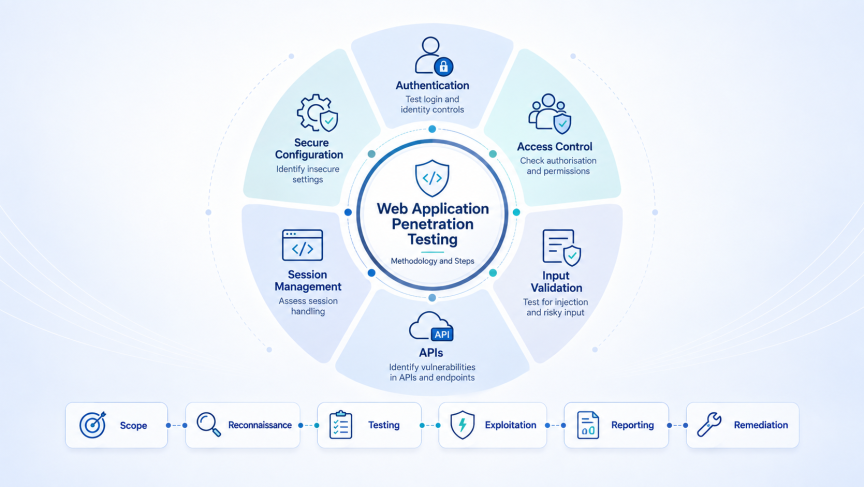
A structured web application penetration testing methodology helps ensure that assessments are consistent, controlled and focused on relevant risks.
The exact methodology will vary according to the application and testing provider, but most engagements follow several common stages.
1. Scoping and Planning
Before testing begins, the organisation and penetration-testing provider should agree the scope and rules of engagement.
This should define:
- Applications and domains being tested
- APIs and supporting services included
- User accounts and roles
- Environments within scope
- Permitted testing techniques
- Testing periods
- Excluded systems or activities
- Escalation procedures
- Data-handling requirements
- Reporting expectations
- Contacts during the engagement
Clear authorisation is essential because penetration testing intentionally attempts to bypass security controls.
The scope should also reflect the organisation’s security objectives. Testing a public website may require a different approach from testing an authenticated customer portal containing sensitive information.
2. Information Gathering and Reconnaissance
The tester develops an understanding of the application and its surrounding technology.
Information gathering may identify:
- Application functionality
- Domains and subdomains
- Technologies and frameworks
- APIs
- Authentication mechanisms
- User roles
- Web servers
- Cloud services
- Third-party integrations
- Exposed files or directories
- Application endpoints
Reconnaissance can be passive or active.
Passive reconnaissance gathers information without directly interacting extensively with the target, while active reconnaissance involves making requests to the application or connected services.
Understanding the application’s architecture helps testers identify potentially valuable attack paths and determine where deeper assessment is required.
3. Mapping the Application
Modern web applications may contain hundreds or thousands of functions and endpoints.
Testers therefore map the application to understand how its components interact.
This may include identifying:
- Public pages
- Authenticated areas
- Administrative interfaces
- APIs
- Upload functionality
- Payment processes
- Password-reset mechanisms
- Search features
- User-management functions
- Data-entry forms
- Account settings
- Backend communications
The objective is to build an accurate picture of the application’s attack surface.
4. Vulnerability Assessment
The tester begins assessing the application for security weaknesses.
Automated tools may be used to identify potential issues, but findings should be validated manually wherever appropriate.
Testing may examine:
- Access controls
- Authentication
- Session management
- Input handling
- Application configuration
- Encryption
- API security
- Business logic
- Error handling
- File processing
- Third-party components
- Server behaviour
Automated scanning can provide broad coverage, but penetration testing requires additional analysis to determine whether findings are genuine and exploitable.
5. Controlled Exploitation
Where authorised, the tester attempts to exploit selected vulnerabilities.
The purpose is to determine what an attacker could realistically achieve.
For example, the tester may assess whether a weakness allows them to:
- Access another user’s account
- Retrieve sensitive data
- Elevate privileges
- Execute unauthorised commands
- Bypass authentication
- Manipulate transactions
- Upload dangerous files
- Interact directly with backend systems
Testing should remain proportionate to the objective.
The aim is to demonstrate risk without causing unnecessary disruption, damaging systems or accessing more information than required.
6. Post-Exploitation Analysis
Once access has been demonstrated, the tester may assess how significant the compromise could become.
This can include determining whether an attacker could:
- Reach additional information
- Compromise further accounts
- Increase privileges
- Access administrative functionality
- Interact with connected services
- Move from the application into supporting infrastructure
This helps distinguish an isolated vulnerability from a weakness that could lead to a more serious security incident.
7. Reporting and Remediation
The penetration-testing report should clearly explain what was tested and what was discovered.
A useful report should include:
- Assessment scope
- Testing methodology
- Limitations
- Confirmed vulnerabilities
- Evidence of exploitation
- Business impact
- Risk ratings
- Remediation recommendations
- Priority actions
Technical findings should be presented in a way that enables development, IT and security teams to understand what needs to be corrected.
Risk should not be determined solely by technical severity. The business context of the affected system and information should also be considered.
8. Retesting
After vulnerabilities have been remediated, targeted retesting can confirm whether the fixes have been implemented effectively.
Retesting is important because changes intended to resolve one vulnerability may occasionally introduce another issue or fail to address the underlying cause.
Common Web Application Vulnerabilities
Web applications can contain a wide range of vulnerabilities.
The OWASP Web Security Testing Guide provides widely used guidance for assessing areas such as authentication, authorisation, session management, configuration, input validation, cryptography, business logic and API security.
The OWASP Top 10 also highlights major categories of web application security risk.
Common areas examined during testing include the following.
Broken Access Control
Access-control weaknesses occur when users can access functionality or information they should not be permitted to use.
Examples may include:
- Viewing another customer’s records
- Accessing administrative pages
- Changing another user’s information
- Performing privileged actions
- Manipulating identifiers to access restricted resources
Broken access control can be particularly serious because it may allow an authenticated user to bypass restrictions without needing to compromise another account.
Authentication Failures
Authentication weaknesses can allow attackers to compromise user accounts or impersonate legitimate users.
Testing may examine:
- Password controls
- Login functionality
- Multi-factor authentication
- Password-reset processes
- Account recovery
- Brute-force protection
- Credential handling
Session Management Weaknesses
After a user signs in, the application must maintain their authenticated session securely.
Testing may assess:
- Session tokens
- Cookie security
- Session expiry
- Logout behaviour
- Session fixation
- Token reuse
- Concurrent sessions
Weak session controls can allow attackers to hijack legitimate user sessions.
Injection Vulnerabilities
Injection occurs when untrusted input is interpreted as a command or query by another system.
Examples include:
- SQL injection
- NoSQL injection
- Command injection
- LDAP injection
- Server-side template injection
Successful injection can potentially expose information or allow attackers to interact with backend systems.
Cross-Site Scripting
Cross-site scripting, or XSS, occurs when an application allows malicious script content to execute within another user’s browser.
Depending on the application and vulnerability, this could be used to manipulate content, steal information or perform actions within a user’s session.
Security Misconfiguration
Applications can become vulnerable through insecure settings rather than flaws in the application code itself.
Examples include:
- Default accounts
- Exposed administration interfaces
- Excessive permissions
- Debug functionality
- Verbose error messages
- Unnecessary services
- Incorrect security headers
- Insecure cloud configuration
Cryptographic Failures
Applications handling sensitive information should protect it appropriately when stored and transmitted.
Testing may examine:
- Encryption
- Certificate configuration
- Transport security
- Password storage
- Cryptographic keys
- Sensitive information exposed in application responses
Insecure Design and Business Logic
Some vulnerabilities arise because an application’s workflow itself can be abused.
For example, an attacker might:
- Alter the value of a transaction
- Skip an approval stage
- Reuse a one-time action
- Obtain a discount repeatedly
- Change account ownership
- Perform activities in an unintended sequence
These weaknesses are particularly difficult for automated scanners to identify because understanding them requires knowledge of how the application is supposed to behave.
Software Supply Chain and Third-Party Components
Modern applications often depend on third-party libraries, packages, APIs and software services.
Weaknesses can arise from:
- Vulnerable dependencies
- Compromised packages
- Unsupported components
- Insecure integrations
- Weak supplier controls
- Inadequate update processes
Testing should therefore consider not only proprietary application code but also the wider ecosystem supporting it.
Logging and Alerting Failures
An application may be vulnerable even where preventative controls are strong if suspicious activity cannot be detected.
Testing may determine whether important actions generate appropriate logs and whether those logs support investigation and incident response.
Automated Testing Versus Manual Penetration Testing
Automated security tools are valuable, but they are not equivalent to a full penetration test.
Automated scanners can efficiently identify known vulnerability patterns across large applications.
They are useful for areas such as:
- Vulnerable software versions
- Common misconfigurations
- Certain injection flaws
- Missing security headers
- Known vulnerability signatures
Manual testing adds context and judgement.
A penetration tester may identify:
- Business-logic vulnerabilities
- Multi-stage attack paths
- Complex access-control failures
- Authentication bypasses
- Vulnerabilities requiring multiple conditions
- Application-specific weaknesses
- Unexpected interactions between functions
Effective web application testing therefore normally combines automated tooling with manual analysis.
How Often Should Web Applications Be Tested?
There is no single testing frequency appropriate for every organisation.
A penetration test is a point-in-time assessment, so the appropriate schedule should reflect the application’s risk and rate of change.
Additional testing may be appropriate:
- Before launching a significant new application
- Following major application changes
- After substantial infrastructure changes
- Following a cloud migration
- After introducing new authentication systems
- After major API changes
- Following a serious security incident
- When new contractual requirements apply
- When the organisation’s risk profile changes
Frequently changing or high-risk applications may require more regular assessment.
Penetration testing should also form part of a wider vulnerability-management programme rather than being relied upon as the only method of identifying security weaknesses.
Integrating Testing into Application Security
Testing is most valuable when findings are used to improve security practices rather than simply close individual vulnerabilities.
Recurring weaknesses may indicate broader problems in:
- Software development
- Security architecture
- Access-control design
- Dependency management
- Cloud configuration
- Change management
- Security testing during development
Organisations can therefore use penetration-testing results to improve secure development practices and reduce the likelihood of similar weaknesses appearing in future releases.
Activities such as static application security testing, dynamic testing, dependency scanning and secure code review can complement formal penetration testing throughout the software development lifecycle.
Strengthening Web Application Security
Web application penetration testing gives organisations a controlled way to identify and validate exploitable weaknesses before they can be used in a real attack. Effective testing should be properly scoped and authorised, combine automated tools with manual expertise, and translate technical findings into clear remediation priorities.
A penetration test should not, however, be treated as proof that an application will remain secure indefinitely. Applications, dependencies, configurations and infrastructure change over time, so testing should sit alongside secure development practices, vulnerability management, security updates, monitoring and targeted retesting following significant changes.
SeCore’s Penetration Testing services help organisations assess web applications, validate real-world exploitability, understand potential business impact and prioritise remediation. By combining structured penetration testing with wider security assurance, organisations can strengthen application security and reduce exposure as their digital environments evolve.