A penetration test can identify security weaknesses, demonstrate how vulnerabilities could be exploited and help organisations understand their exposure to cyber threats.
However, receiving a penetration testing report does not mean that those risks have been resolved.
Even after remediation has been completed, organisations may have limited evidence that security fixes are effective. A software update, configuration change or additional security control may address part of a vulnerability without fully resolving the underlying weakness.
Penetration testing retesting helps organisations determine whether previously identified vulnerabilities have been successfully remediated.
By validating security improvements through targeted technical testing, organisations can reduce uncertainty, identify remaining weaknesses and gain greater confidence in their security posture.
What Is Penetration Testing Retesting?
Penetration testing retesting is a follow-up security assessment conducted after an organisation has taken action to address vulnerabilities identified during an earlier penetration test.
The primary objective is to establish whether the original vulnerabilities remain exploitable following remediation.
Retesting may involve examining:
- Previously identified security vulnerabilities
- Updated software and applications
- Revised security configurations
- Authentication and authorisation controls
- Network access restrictions
- Newly implemented protective measures
Unlike a full penetration test, retesting typically focuses on specific findings and affected systems within an agreed scope.
It provides technical evidence of whether remediation has achieved its intended security outcome.
Why Is Penetration Testing Retesting Important?
Organisations often manage penetration testing findings through internal remediation plans, development tasks or vulnerability management systems.
Once a task has been completed, the associated vulnerability may be marked as resolved.
However, completing a remediation task is not necessarily the same as eliminating a security weakness.
For example, an organisation may introduce additional access restrictions to protect sensitive information. Although the configuration has been updated, alternative access paths may still allow unauthorised users to reach the same information.
Retesting helps establish whether the security risk has genuinely been addressed.
It can also support:
- Greater confidence in security improvements
- Reduced exposure to previously identified vulnerabilities
- Improved remediation accountability
- Stronger evidence for compliance and audit activities
- More informed cyber risk management decisions
Without verification, organisations may underestimate their remaining exposure.
Penetration Testing vs Penetration Testing Retesting
Although both activities involve technical security assessment, they serve different purposes.
| Penetration Testing | Penetration Testing Retesting |
| Identifies and validates security weaknesses | Verifies previously identified weaknesses |
| Typically examines a broader attack surface | Focuses on agreed findings and affected systems |
| Establishes an initial understanding of exposure | Evaluates the effectiveness of remediation |
| Produces findings and recommendations | Produces updated findings and verification evidence |
| May identify previously unknown vulnerabilities | Primarily confirms whether known issues remain |
Retesting should not be considered a replacement for periodic penetration testing.
New vulnerabilities may emerge as organisations introduce applications, update infrastructure and change security configurations.
A targeted retest provides confidence in specific improvements, while broader assessments help identify new and evolving security risks.
Common Vulnerabilities That Require Retesting
The appropriate retesting approach depends on the nature of the original findings.
Authentication Weaknesses
Changes to authentication mechanisms should be validated to establish whether unauthorised access is adequately prevented.
This may include reviewing multi-factor authentication, session management and account recovery controls.
Broken Access Controls
Access-control vulnerabilities may allow users to reach information or functionality beyond their authorised permissions.
Retesting helps determine whether updated permissions and authorisation mechanisms enforce the intended restrictions.
Software Vulnerabilities
Applying security patches can address known software vulnerabilities.
However, verification may be necessary to establish whether the correct updates have been deployed across all affected systems and whether the original weakness remains exploitable.
Security Misconfigurations
Configuration changes may be introduced to address exposed services, excessive permissions or insecure system settings.
Retesting helps confirm that these changes have been implemented correctly and consistently.
Network Segmentation Weaknesses
Organisations may strengthen network boundaries following a penetration test.
Follow-up testing can help establish whether restricted systems remain accessible through unintended network paths.
Business Logic Vulnerabilities
Business logic weaknesses often require changes to application workflows rather than straightforward software updates.
Manual retesting can help determine whether revised workflows prevent the original unauthorised behaviour.
How Does Penetration Testing Retesting Work?
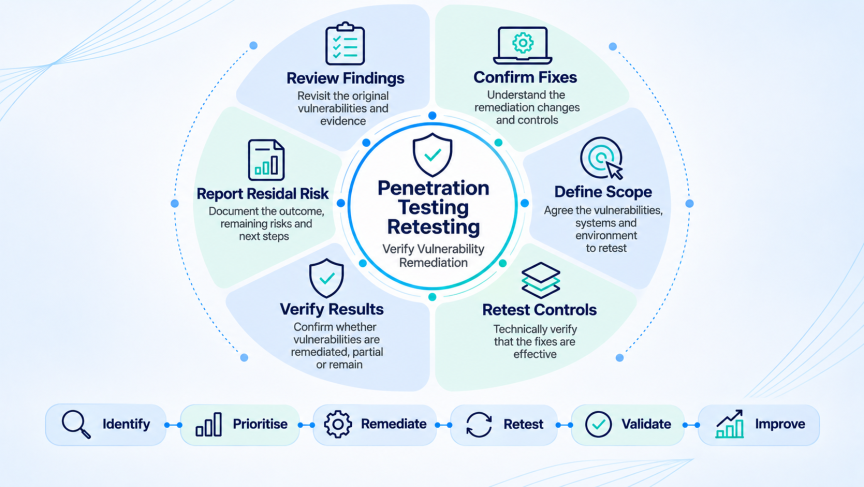
An effective retesting process follows a structured approach that connects the original findings with the remediation activities and their verified outcomes.
1. Review the Original Penetration Testing Report
The tester reviews the original findings, affected assets, supporting evidence and potential business impact.
This establishes the baseline against which remediation will be assessed.
2. Confirm Remediation Activities
The organisation provides information about the changes made to address each vulnerability.
These may include software updates, configuration changes, application modifications or additional security controls.
Understanding the changes helps establish an appropriate retesting approach.
3. Define the Retesting Scope
The organisation and testing provider agree which vulnerabilities, systems and environments will be reassessed.
The scope should also consider whether changes have affected related components or security controls.
Testing must remain within agreed and authorised boundaries.
4. Perform Targeted Security Testing
The tester reassesses the original vulnerabilities using appropriate technical methods.
Where relevant, testing may also examine alternative scenarios to determine whether remediation has addressed the underlying weakness rather than only the original method of exploitation.
5. Evaluate Remediation Effectiveness
Each finding is assessed against the results of the retest.
Typical finding statuses may include:
- Remediated: The original weakness could no longer be reproduced within the agreed testing scope.
- Partially remediated: Improvements have been made, but aspects of the weakness remain.
- Not remediated: The original vulnerability remains present.
- Not verified: Available access, evidence or testing conditions were insufficient to establish the outcome.
Clearly distinguishing these outcomes helps organisations understand which risks remain outstanding.
6. Document Results and Remaining Risks
The retesting report records the updated status of each finding, supporting evidence and any further remediation recommendations.
This provides a clear record of security improvements and outstanding actions.
When Should Organisations Conduct Penetration Testing Retesting?
Retesting should generally take place once the relevant remediation activities have been implemented and the affected environment is ready for assessment.
The appropriate timing depends on factors such as vulnerability severity, business impact, system exposure and the complexity of the required changes.
Critical and high-risk vulnerabilities should receive particular attention, especially where they affect internet-facing services, sensitive information or essential business operations.
Organisations should also consider retesting following:
- Significant application security fixes
- Changes to privileged access controls
- Security-related infrastructure modifications
- Remediation of previously demonstrated attack paths
- Implementation of compensating security controls
Retesting does not need to wait until every finding has been addressed. Higher-risk vulnerabilities can be reassessed separately where this supports faster risk reduction.
Is Vulnerability Scanning Sufficient for Retesting?
Automated vulnerability scanning can be useful for verifying software updates, identifying known vulnerabilities and checking certain security configurations.
However, automated scanning may not provide sufficient evidence for every penetration testing finding.
Vulnerabilities involving business logic, complex authorisation mechanisms or combinations of security weaknesses often require manual technical assessment.
For example, a scanner may confirm that a software component has been updated without establishing whether an application still permits unauthorised access to sensitive information.
The verification method should therefore reflect the nature of the vulnerability.
Automated scanning and manual penetration testing can complement each other as part of a broader remediation verification process.
Common Penetration Testing Remediation Mistakes
Several common mistakes can reduce the effectiveness of remediation activities.
Addressing symptoms rather than underlying weaknesses: A fix may prevent one method of exploitation while leaving the broader security issue unresolved.
Testing the wrong environment: Remediation may be verified in a development environment without confirming that equivalent changes have reached production.
Overlooking affected systems: A vulnerability may be resolved on one system while remaining present elsewhere.
Treating temporary mitigations as permanent fixes: Additional protective measures may reduce immediate exposure without eliminating the underlying vulnerability.
Closing findings without verification: Internal records may indicate that remediation is complete even though technical evidence is unavailable.
A structured retesting process helps identify these issues before organisations rely on remediation as evidence of improved security.
Penetration Testing Retesting and Compliance
Penetration testing reports can provide valuable evidence for regulatory assessments, security audits and customer assurance activities.
However, the initial report primarily establishes which weaknesses were identified at the time of testing.
A retesting report can provide additional evidence demonstrating:
- Which vulnerabilities have been addressed
- Whether security improvements have been technically verified
- Which weaknesses remain outstanding
- How remediation activities have progressed
Specific testing and remediation obligations vary according to the applicable regulation, standard or contractual requirement.
Organisations should therefore ensure that their verification activities align with the requirements relevant to their business.
Retesting supports compliance preparation but does not independently establish compliance or certification.
Measuring Security Improvements After Penetration Testing
Organisations should aim to understand how remediation activities contribute to meaningful security improvements.
Useful measures may include the proportion of findings successfully remediated, the time taken to resolve high-risk vulnerabilities and the number of recurring security weaknesses.
However, these measures should be interpreted alongside the severity and business impact of individual findings.
Resolving several low-risk vulnerabilities may deliver less meaningful risk reduction than addressing a single weakness affecting a critical business system.
Combining remediation tracking with technical verification and risk-based assessment provides a clearer understanding of security progress.
Turning Penetration Testing Findings into Verified Security Improvements
Penetration testing provides valuable insight into security weaknesses, but its long-term value depends on how effectively organisations address the findings.
Retesting helps close the gap between implementing security fixes and demonstrating that those fixes work.
By validating remediation, identifying remaining weaknesses and maintaining reliable evidence, organisations can make more informed security decisions and reduce uncertainty surrounding their cyber risk.
SeCore’s Penetration Testing services help organisations identify exploitable vulnerabilities, understand their potential business impact and prioritise remediation activities.
Through structured technical assessment and evidence-based verification, organisations can move beyond identifying security weaknesses towards demonstrating measurable improvements in their security posture.