Application Programming Interfaces, or APIs, allow applications, platforms and services to exchange information and perform actions.
They are central to modern digital environments. Mobile applications use APIs to communicate with backend systems, cloud services expose APIs for automation, and organisations increasingly connect internal systems, suppliers and customers through API-driven services.
This connectivity also creates security risk.
An API may expose sensitive information or powerful business functions directly to other systems. Weak authorisation, insecure authentication or poorly designed endpoints can therefore allow an attacker to access information or functionality that should not be available to them.
API penetration testing is an authorised security assessment that simulates realistic attacks against an API to identify and validate exploitable weaknesses.
The objective is not simply to identify insecure endpoints. Effective testing determines whether weaknesses can be combined, what an attacker could access and what the resulting business impact could be.
What Is API Penetration Testing?
API penetration testing examines the security of interfaces used by applications and services to communicate.
Testing may assess:
- REST APIs
- GraphQL APIs
- SOAP services
- Internal APIs
- Public APIs
- Partner APIs
- Mobile application backends
- Cloud service interfaces
The tester attempts to understand how the API works, which resources it exposes and how access is controlled.
The assessment may determine whether an attacker can:
- Access another user’s information
- Perform unauthorised actions
- Bypass authentication
- Increase privileges
- Manipulate API requests
- Abuse business processes
- Consume excessive resources
- Discover undocumented endpoints
- Exploit connected third-party services
As with any penetration test, testing should take place within an agreed and authorised scope.
Why API Security Requires Specific Testing
APIs can behave differently from conventional web interfaces.
A web application may restrict what users can see through its graphical interface, while the underlying API exposes a wider range of functions.
Attackers are not limited to using the application as intended.
They can interact directly with API endpoints, modify requests and attempt to access objects or functions the normal interface does not expose.
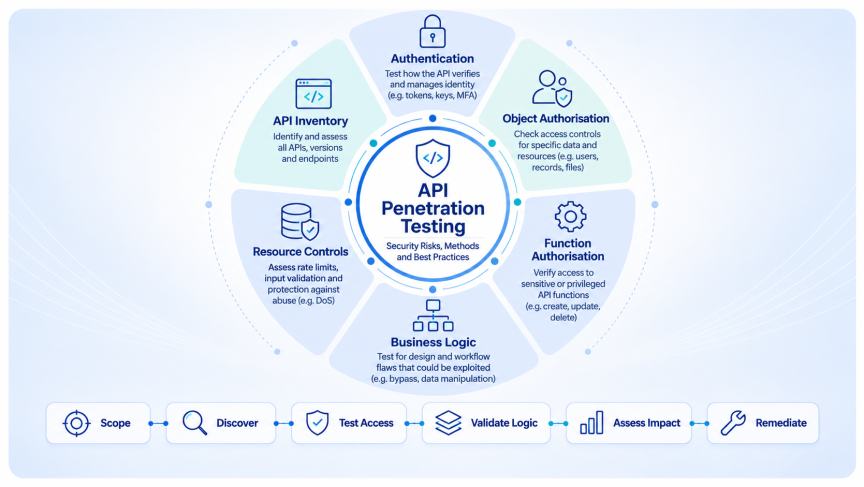
API testing therefore focuses heavily on:
- Authentication
- Authorisation
- Object access
- Business logic
- Input handling
- Resource consumption
- Endpoint inventory
- Third-party integrations
Automated scanning can identify some weaknesses, but many API vulnerabilities require an understanding of how users, objects and business processes interact.
Scoping an API Penetration Test
A useful API assessment begins with a clear scope.
This may include:
- API domains
- Endpoint collections
- API versions
- User roles
- Authentication methods
- Test accounts
- Mobile or web clients
- Connected services
- Production restrictions
The organisation should also provide relevant documentation where appropriate.
This may include:
- OpenAPI or Swagger specifications
- GraphQL schemas
- Postman collections
- Authentication details
- Architecture information
Providing documentation does not reduce the value of testing.
It can allow the tester to spend more time examining security behaviour rather than discovering basic functionality.
API Reconnaissance and Discovery
Before testing vulnerabilities, the tester needs to understand the API attack surface.
This may involve identifying:
- Available endpoints
- Supported HTTP methods
- Parameters
- Object identifiers
- Authentication requirements
- API versions
- Error responses
- Connected services
One important objective is identifying endpoints that may not be documented or actively maintained.
Older API versions, development endpoints or forgotten services can remain accessible even after the main application has moved to a newer interface.
These endpoints can create additional exposure if they no longer receive the same security attention.
Authentication Testing
Authentication determines whether the API can establish who is making a request.
Testing may assess:
- Login mechanisms
- API keys
- Access tokens
- Refresh tokens
- OAuth implementations
- Session management
- Multi-factor authentication
- Password-reset processes
Weaknesses may allow attackers to obtain or reuse credentials, manipulate authentication flows or access services without appropriate verification.
Authentication should also be tested across different endpoints.
Protecting one part of the API does not guarantee that every function requires the same level of authentication.
Object-Level Authorisation
One of the most important API security risks is broken object-level authorisation.
APIs frequently use object identifiers to request specific information.
For example, an application might request:
/accounts/12345
The API must confirm not only that the user is authenticated, but that they are authorised to access account 12345.
If the server relies on the user to provide the correct identifier without checking ownership or permissions, an attacker may be able to change the identifier and access another user’s information.
Testing therefore attempts to determine whether users can access objects belonging to:
- Other customers
- Other employees
- Different organisations
- Higher-privileged accounts
This type of weakness can expose sensitive information even when authentication itself is functioning correctly.
Function-Level Authorisation
APIs also need to control which functions each user can perform.
A standard user should not be able to access administrative functionality simply by discovering the correct endpoint.
Testing may assess whether users can:
- Create privileged accounts
- Delete resources
- Modify security settings
- Access administrative endpoints
- Approve transactions
- Perform management actions
The API should enforce authorisation on the server rather than relying on the client application to hide restricted functionality.
Object Property-Level Authorisation
APIs often allow users to read or update individual properties within an object.
For example, a user may legitimately be able to change their display name but should not be able to change an administrative role or account status.
Testing can identify whether requests can manipulate sensitive fields that should not be available to the user.
This is particularly important where APIs accept complex JSON objects containing many properties.
Business Logic and Sensitive Workflows
Some of the most serious API weaknesses are not traditional software vulnerabilities.
They arise because a legitimate function can be abused.
Examples might include:
- Repeatedly applying a discount
- Bypassing an approval stage
- Reserving limited resources at scale
- Reusing a one-time action
- Manipulating transaction sequences
- Automating a process intended to have human limits
These vulnerabilities require testers to understand the purpose of the application.
An automated scanner may confirm that the endpoint works correctly while missing the fact that the workflow itself can be abused.
Resource Consumption and Rate Controls
APIs can consume significant computing, database or third-party resources.
An attacker may attempt to generate large numbers of requests or deliberately request expensive operations.
Testing may examine:
- Rate limits
- Request size
- Pagination
- File processing
- Search functionality
- Database-intensive queries
- GraphQL query complexity
Inadequate controls can result in degraded performance, increased infrastructure costs or service disruption.
Testing should remain controlled so that production environments are not unnecessarily affected.
Server-Side Request Forgery
Some APIs retrieve information from URLs or services supplied by users.
If these requests are not sufficiently restricted, an attacker may be able to make the server communicate with unintended systems.
This is known as Server-Side Request Forgery, or SSRF.
Depending on the environment, SSRF may expose:
- Internal services
- Cloud metadata
- Administrative interfaces
- Restricted network resources
Testing should determine whether user-controlled destinations are validated appropriately.
Security Misconfiguration
APIs can also become vulnerable through configuration weaknesses.
Examples include:
- Excessive error information
- Weak transport security
- Unnecessary HTTP methods
- Insecure cross-origin settings
- Default credentials
- Exposed management interfaces
- Debug functionality
Configuration should be consistent across development, testing and production environments.
API Inventory Management
Organisations can only protect APIs they know exist.
Large environments may contain:
- Multiple versions
- Development APIs
- Internal services
- Deprecated endpoints
- Partner integrations
- Shadow APIs
Older versions can remain exposed after developers stop actively maintaining them.
API inventories should therefore identify which services exist, who owns them and whether they are still required.
Penetration testing can help identify endpoints that differ from the organisation’s documented view of the environment.
Third-Party API Risk
Modern applications frequently depend on APIs operated by other organisations.
Developers may assume that information received from a trusted third-party service is safe.
That assumption can create risk.
An attacker may compromise or manipulate an external service, or malicious information may enter the application through an integration.
Organisations should therefore validate information received from third-party APIs and consider how external services affect their attack surface.
API Penetration Testing and the OWASP API Security Top 10
The OWASP API Security Top 10 provides a useful reference for common API security risks.
The current categories include:
- Broken Object Level Authorisation
- Broken Authentication
- Broken Object Property Level Authorisation
- Unrestricted Resource Consumption
- Broken Function Level Authorisation
- Unrestricted Access to Sensitive Business Flows
- Server-Side Request Forgery
- Security Misconfiguration
- Improper Inventory Management
- Unsafe Consumption of APIs
These categories provide useful coverage, but they should not become a fixed checklist.
The assessment should also consider the specific application, users, architecture and business processes being tested.
API Penetration Testing vs Web Application Testing
API and web application penetration testing frequently overlap.
A modern web application may use APIs for most of its backend functionality.
However, an API assessment places additional emphasis on:
- Direct endpoint interaction
- Object identifiers
- Machine-to-machine authentication
- API tokens
- Function-level permissions
- Business workflows
- Endpoint inventories
A web application may appear secure when used through its intended interface while still exposing weaknesses through the underlying API.
Testing both layers can therefore provide a more complete view.
Reporting and Remediation
The final report should explain:
- Which APIs were tested
- Which roles were assessed
- Confirmed vulnerabilities
- Exploitation evidence
- Affected endpoints
- Business impact
- Risk ratings
- Remediation recommendations
Remediation may include:
- Strengthening authorisation checks
- Improving authentication
- Restricting sensitive fields
- Introducing rate controls
- Removing obsolete endpoints
- Validating third-party information
- Improving API inventories
- Correcting configuration weaknesses
Findings should be prioritised according to realistic impact rather than technical severity alone.
Retesting API Vulnerabilities
Important API vulnerabilities should be retested after remediation.
This confirms whether:
- Access controls have been corrected
- Sensitive objects remain protected
- Restricted functions can no longer be reached
- Business-logic abuse has been prevented
- Old endpoints have been removed
Retesting provides stronger evidence that the original attack path has actually been closed.
Strengthening API Security Through Penetration Testing
APIs connect applications, users and services across modern digital environments, but that connectivity can expose sensitive information and powerful business functions if access controls are not implemented correctly.
Effective API penetration testing should examine more than individual technical vulnerabilities. It should test authentication, object and function-level authorisation, business logic, resource controls, API inventories and connected services to determine what an attacker could realistically achieve.
Because APIs continue to change as applications evolve, testing should form part of a wider programme that includes secure development, vulnerability management, access control, monitoring and remediation verification.
SeCore’s Penetration Testing services help organisations identify exploitable API weaknesses, validate access controls and understand realistic business impact. By combining structured technical testing with clear remediation priorities, organisations can strengthen API security and gain greater confidence in the services connecting their digital environments.