Traditional cyber security models often assume that users and devices connected to an organisation’s internal network can be trusted more than those outside it.
However, modern organisations operate across cloud platforms, remote working environments, mobile devices and third-party services. A compromised account or device can expose critical systems if access is granted primarily because of network location.
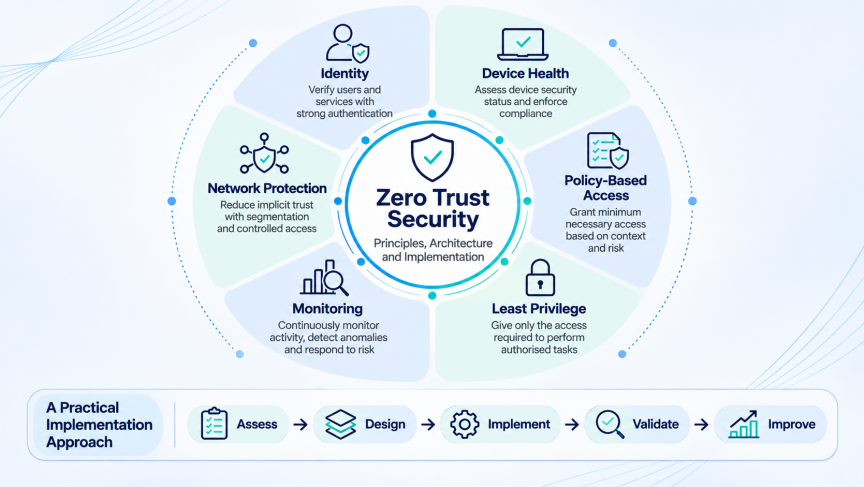
Zero Trust security addresses this challenge by removing implicit trust and requiring access to be evaluated according to identity, device health, context and security policy.
Rather than relying on a single network perimeter, Zero Trust focuses on protecting individual applications, services and information.
This guide explains how Zero Trust works, the principles behind it and how organisations can implement and assess its effectiveness.
What Is Zero Trust Security?
Zero Trust is a cyber security architecture in which users, devices and services are not automatically trusted simply because they are connected to an internal network.
Every request to access a protected resource should be authenticated and authorised according to defined security policies.
Access decisions may consider:
-
User and service identity
-
Device identity and security health
-
Authentication strength
-
Access permissions
-
Requested applications and information
-
Behavioural and contextual risk signals
For example, an employee using valid credentials may still be required to complete additional authentication before accessing sensitive financial information or administrative functions.
The objective is to ensure that access remains appropriate to the identity, device, resource and level of risk involved.
Why Traditional Network Security Is Changing
Traditional security architectures were often built around a network perimeter.
Users outside the organisation faced security controls, while those connected to the internal network could receive broader access.
This approach becomes less effective when organisations depend on cloud applications, remote employees, suppliers and distributed services.
Attackers can also obtain legitimate credentials through phishing, malware or other forms of compromise.
Once inside a network, excessive permissions and unrestricted connectivity may allow an attacker to access additional systems.
Zero Trust reduces this reliance on network location by requiring access to be explicitly evaluated and restricted.
The Eight NCSC Zero Trust Principles
The UK’s National Cyber Security Centre (NCSC) identifies eight design principles to help organisations develop and evaluate Zero Trust architectures.
1. Know Your Architecture
Organisations should understand the users, devices, services, applications and information within their environment.
This includes identifying critical resources, dependencies and existing access arrangements.
Accurate visibility helps establish appropriate security policies and identify potential exposure.
2. Know Your Identities
Users, devices and services should have reliable, distinguishable identities.
This includes employee accounts, privileged users, automated processes and machine identities.
Strong identity management allows organisations to make more informed access decisions.
3. Assess Behaviour and Health
Authentication alone does not establish that an access request is safe.
Organisations should consider device configuration, security update status, endpoint protection and unusual account activity.
These signals can help determine whether access should be permitted, restricted or challenged.
4. Use Policies to Authorise Requests
Access should be governed by defined security policies.
Policies may consider identity, device condition, resource sensitivity and other contextual information.
This enables more granular and risk-based access decisions.
5. Authenticate and Authorise Everywhere
Every protected resource should require appropriate authentication and authorisation.
Multi-factor authentication strengthens identity verification, while authorisation determines which resources and functions an identity may access.
Both are essential to preventing unauthorised activity.
6. Monitor Users, Devices and Services
Monitoring provides visibility into security events, unusual behaviour and changes in device or service health.
This information helps organisations identify threats and evaluate whether access policies are operating effectively.
7. Do Not Automatically Trust Any Network
Internal networks should not automatically be considered trustworthy.
Communications should be appropriately protected, and access should remain subject to authentication and authorisation.
This can reduce opportunities for lateral movement following a compromise.
8. Choose Services That Support Zero Trust
Organisations should consider whether their technologies support modern authentication, granular authorisation, secure communications and security monitoring.
Legacy applications may require additional protective controls where these capabilities are unavailable.
Zero Trust vs Zero Trust Network Access
Zero Trust Network Access (ZTNA) is a technology approach that supports Zero Trust principles, particularly when providing access to applications and services.
Traditional remote-access solutions may provide connectivity to a wider network.
ZTNA can instead restrict access to individual applications according to identity, device condition and policy.
However, ZTNA is not equivalent to a complete Zero Trust architecture.
Zero Trust also includes identity management, device security, service authentication, monitoring, data protection and security governance.
An organisation should therefore avoid assuming that deploying ZTNA automatically establishes comprehensive Zero Trust security.
Identity and Least-Privilege Access
Identity is central to Zero Trust because attackers frequently target credentials and privileged accounts.
Organisations should strengthen identity security through measures such as:
-
Multi-factor authentication
-
Privileged access management
-
Role-based permissions
-
Regular access reviews
-
Account lifecycle management
-
Service identity controls
These measures should support least-privilege access, where users and services receive only the permissions necessary to perform authorised activities.
For example, compromising a standard employee account should not automatically provide access to administrative systems or unrelated sensitive information.
Reducing unnecessary permissions limits the potential consequences of an account compromise.
Device Security and Continuous Verification
A legitimate user may attempt to access organisational resources from a compromised or poorly configured device.
Zero Trust therefore considers device security alongside identity.
Relevant security signals may include:
-
Device management status
-
Operating system updates
-
Endpoint protection
-
Encryption
-
Security configuration
-
Device certificates
Access can be restricted where devices do not meet defined requirements.
Where supported, access decisions can also be reassessed when conditions change during a session.
This reduces the risk of relying indefinitely on an earlier successful authentication.
Zero Trust and Network Segmentation
Network segmentation remains an important security control.
Separating systems and restricting communication between environments can limit the impact of a compromise.
However, segmentation alone does not establish Zero Trust.
A Zero Trust architecture can combine segmentation with identity-aware access controls, device verification and application-specific policies.
This provides more granular protection than relying exclusively on network boundaries.
How to Implement Zero Trust
Zero Trust implementation should normally follow a phased approach rather than a single technology migration.
Assess the Existing Environment
Identify users, devices, applications, services, information and current access arrangements.
Prioritise critical resources and understand their dependencies.
Strengthen Identity and Authentication
Improve account management, multi-factor authentication, privileged access and service identity controls.
Establish Device Security Requirements
Define appropriate security standards for devices accessing organisational resources.
Where supported, incorporate device health into access decisions.
Implement Policy-Based Access
Develop access policies that consider identity, device condition, business requirements and resource sensitivity.
Improve Monitoring
Collect and analyse security information across users, devices, applications and services.
Use this information to identify suspicious activity and evaluate access-control effectiveness.
Validate and Refine Controls
Test access restrictions, identify excessive permissions and verify that policies operate as intended.
Introduce changes carefully to avoid unnecessary disruption to legitimate business activity.
Common Zero Trust Implementation Challenges
Organisations may encounter several difficulties when adopting Zero Trust.
Legacy systems: Older applications may not support modern authentication or granular access controls.
Incomplete visibility: Unknown devices, services and accounts can create gaps in security policies.
Excessive complexity: Poorly designed policies may disrupt legitimate access or become difficult to maintain.
Inconsistent implementation: Different environments may apply identity and access requirements differently.
Insufficient validation: Deploying security technologies does not necessarily demonstrate that access restrictions work effectively.
Addressing these challenges requires planning, reliable evidence and ongoing security assessment.
Zero Trust and Security Assurance
Zero Trust relies on multiple interconnected security controls.
An organisation may have multi-factor authentication, device management and access policies in place while still exposing weaknesses through excessive permissions, misconfiguration or poorly protected applications.
Security assurance helps determine whether these controls operate effectively.
Assessment activities may include:
-
Reviewing identity and access controls
-
Evaluating privileged permissions
-
Validating device security requirements
-
Testing network segmentation
-
Assessing application exposure
-
Reviewing monitoring capabilities
-
Identifying exceptions and control gaps
Technical testing can also demonstrate whether access boundaries can be bypassed.
The objective is to provide evidence that the architecture is reducing risk rather than simply confirming that supporting technologies have been deployed.
Building Measurable Confidence in Zero Trust Security
Zero Trust provides a security approach suited to organisations operating across cloud services, remote environments and distributed applications.
By removing implicit network trust and evaluating access according to identity, device health, policy and context, organisations can reduce unnecessary access and limit the impact of compromise.
However, Zero Trust is not achieved through a single technology deployment. Its effectiveness depends on understanding the environment, implementing appropriate controls, monitoring security conditions and continually validating access decisions.
SeCore’s Security Assurance services help organisations assess security architectures, validate controls and identify weaknesses using structured evidence and quantitative cyber risk analysis. By connecting technical validation with risk-based prioritisation, organisations can gain clearer confidence that their Zero Trust architecture is delivering meaningful security improvements.