Organisations are expected to protect increasingly complex environments containing sensitive data, cloud services, connected systems, employees, customers and third-party suppliers. At the same time, they may need to demonstrate that their security practices meet legal obligations, industry standards, contractual requirements and internal policies.
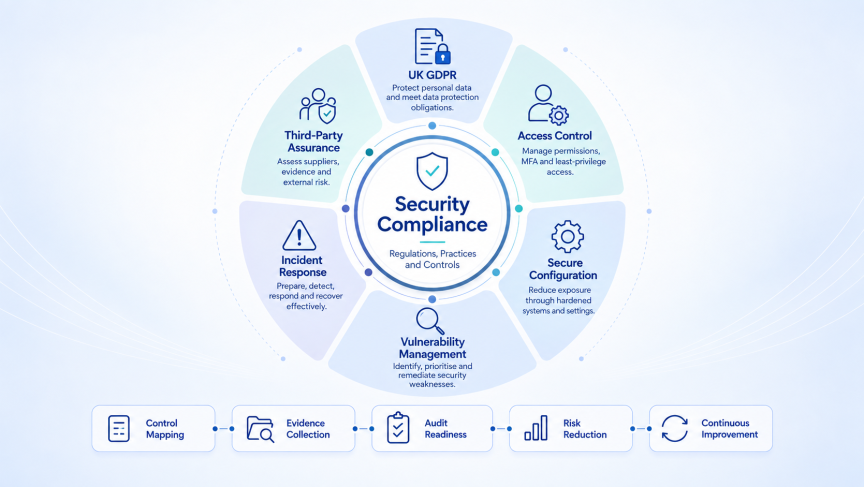
Security Compliance is the process of establishing, maintaining and demonstrating the controls required to meet those obligations.
For UK organisations, security compliance can involve requirements arising from data protection law, sector-specific cyber security regulation, customer contracts and recognised standards or certification schemes. The exact requirements depend on factors such as the organisation’s industry, the information it processes, the services it provides and the markets in which it operates.
Compliance can provide an important security baseline, but meeting a standard does not automatically mean that every cyber risk has been addressed. Effective security compliance should therefore form part of a wider risk-based security programme.
This article explains what security compliance is, the principal requirements relevant to UK organisations, the controls commonly used to support compliance and why organisations should look beyond checklist-based compliance towards measurable security assurance.
What Is Security Compliance?
Security compliance is the process of ensuring that an organisation’s systems, processes and controls meet applicable security requirements.
Those requirements may come from:
- Laws and regulations
- Industry standards
- Certification schemes
- Customer contracts
- Supplier agreements
- Internal policies
- Security frameworks
Compliance involves more than documenting policies.
Organisations also need to establish whether the required controls have actually been implemented, whether they operate effectively and whether sufficient evidence exists to demonstrate that the requirements are being met.
This can involve activities such as:
- Risk assessments
- Security policies
- Access-control reviews
- Vulnerability management
- Security testing
- Staff training
- Supplier assessments
- Incident-response planning
- Audit and evidence collection
- Remediation tracking
Security compliance management is therefore an ongoing process rather than a one-time exercise.
Security and Compliance: What Is the Difference?
Security and compliance are closely connected, but they are not identical.
Cyber Security focuses on protecting systems, networks, applications and information from threats.
The organisation asks questions such as:
- What could be attacked?
- Which vulnerabilities exist?
- What would the impact of a compromise be?
- Which controls are required to reduce the risk?
- Are those controls working effectively?
Compliance focuses on whether the organisation meets a defined set of requirements.
The questions may instead include:
- Which obligations apply?
- Which controls are required?
- Has the organisation implemented them?
- Can the organisation demonstrate this?
- Is appropriate evidence available?
- Are identified gaps being addressed?
A control can therefore support both objectives.
For example, multi-factor authentication may reduce the risk of account compromise while also helping an organisation meet particular regulatory, contractual or certification requirements.
The strongest approach is to align security and compliance rather than manage them as separate activities.
Why Is Security Compliance Important?
Compliance obligations exist partly because failures in security can affect customers, employees, suppliers, markets and essential services.
A structured compliance programme can provide several benefits.
Protecting Sensitive Information
Security requirements often establish controls for protecting personal, confidential or commercially sensitive information.
These may include access controls, encryption, secure configuration, monitoring and incident-management processes.
Reducing Security Risk
Compliance frameworks can provide a structured baseline for identifying controls that might otherwise be overlooked.
They can help organisations establish consistent security practices across systems, departments and locations.
Demonstrating Assurance
Customers and partners increasingly want evidence that suppliers manage cyber security appropriately.
Certification, assessments and documented security controls can support supplier due diligence, procurement and contract negotiations.
Supporting Accountability
Compliance requires organisations to define responsibilities and retain evidence.
This helps establish who owns security risks, who operates individual controls and who is responsible for addressing weaknesses.
Improving Governance
Security compliance can provide management teams with greater visibility of security requirements, risks and remediation priorities.
This allows cyber security to be considered alongside wider operational and business risks.
Key Security Regulations and Requirements for UK Organisations
There is no single security-compliance framework that applies to every UK organisation.
The relevant requirements depend on the organisation, sector, systems, information and services involved.
Several requirements and frameworks are particularly important in the UK.
UK GDPR and the Data Protection Act 2018
Organisations processing personal data in the UK need to consider the security requirements established by UK data protection law.
The UK GDPR requires appropriate technical and organisational measures to protect personal data.
What is appropriate depends on the nature of the processing and the risks involved.
Security measures may include areas such as:
- Access control
- Authentication
- Encryption
- Vulnerability management
- Secure configuration
- Backup and recovery
- Monitoring
- Security testing
- Incident management
The Data Protection Act 2018 operates alongside the UK GDPR and forms part of the UK’s wider data protection framework.
Compliance does not mean applying exactly the same controls to every organisation. The security measures should be proportionate to the information being processed and the associated risk.
Network and Information Systems Regulations
The UK’s Network and Information Systems Regulations 2018 apply to certain organisations involved in essential services and relevant digital services.
They establish security and incident-management requirements for organisations within scope.
Relevant organisations are expected to manage risks to the security of network and information systems and take appropriate measures to prevent or minimise the impact of incidents.
This can involve areas such as:
- Security risk management
- Protection of systems
- Incident detection
- Business continuity
- Monitoring and auditing
- Security testing
- Incident reporting
The requirements are particularly relevant to organisations providing important digital or essential services.
Cyber Essentials
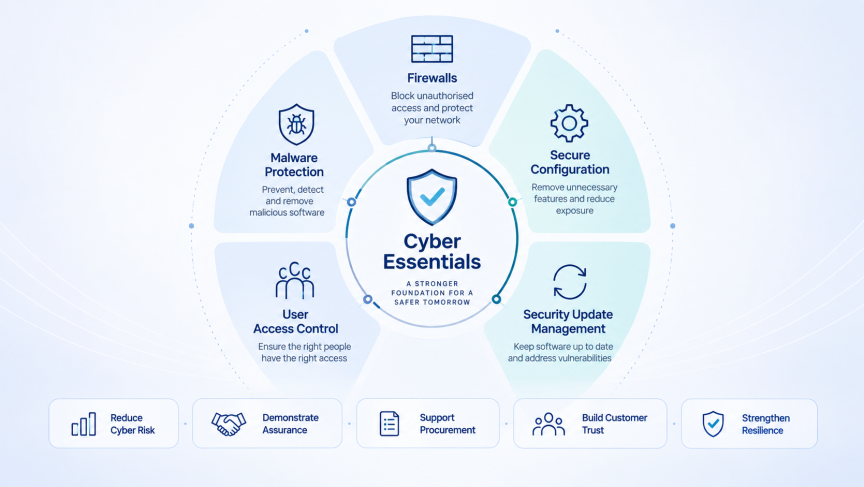
Cyber Essentials is a UK Government-backed cyber security certification scheme focused on protecting organisations against common cyber attacks.
It covers five technical control areas:
- Firewalls
- Secure configuration
- Security update management
- User access control
- Malware protection
Cyber Essentials is not legislation and does not replace wider regulatory compliance.
However, it provides a recognised baseline for cyber security and can support procurement, supplier assurance and wider compliance programmes.
Cyber Essentials Plus provides additional assurance through independent technical testing of the same underlying controls.
ISO/IEC 27001
ISO/IEC 27001 is an international standard for information security management systems.
Rather than concentrating on individual technical controls alone, ISO 27001 provides a structured approach to managing information-security risk across an organisation.
This includes areas such as:
- Risk assessment
- Governance
- Policies
- Access control
- Supplier relationships
- Incident management
- Business continuity
- Asset management
- Security monitoring
- Continual improvement
ISO 27001 certification can provide external assurance that an organisation operates an information security management system against the requirements of the standard.
NCSC Cyber Assessment Framework
The National Cyber Security Centre’s Cyber Assessment Framework provides a structured approach for assessing cyber security and resilience.
It is particularly relevant to organisations responsible for important functions and services.
The framework considers areas including:
- Managing security risk
- Protecting systems against cyber attack
- Detecting cyber security events
- Minimising the impact of incidents
The framework can help organisations assess whether security outcomes are being achieved rather than focusing only on whether individual controls exist.
PCI DSS
Organisations that store, process or transmit payment-card information may also need to comply with the Payment Card Industry Data Security Standard.
PCI DSS is an industry standard rather than UK legislation, but it applies internationally within the payment-card ecosystem.
Its requirements cover areas such as:
- Network security
- Secure configuration
- Vulnerability management
- Access control
- Authentication
- Logging and monitoring
- Security testing
- Protection of cardholder information
The applicable compliance process depends on how the organisation handles payment-card data and its role within the payment environment.
Core Security Compliance Controls
Although individual frameworks use different terminology, many security requirements overlap.
Organisations can therefore build a core set of security capabilities that support multiple obligations.
Access Control and Identity Management
Users should receive only the access required to perform their responsibilities.
Controls may include:
- Multi-factor authentication
- Role-based access
- Least privilege
- Privileged account management
- User access reviews
- Account removal processes
- Strong authentication
Access should also be reviewed when employees change roles or leave the organisation.
Security Configuration
Systems should be configured securely rather than relying on default settings.
This may involve:
- Removing unnecessary accounts
- Disabling unused services
- Changing default credentials
- Restricting administrative access
- Applying secure configuration standards
- Reviewing cloud configurations
- Limiting unnecessary network exposure
Vulnerability and Update Management
Known vulnerabilities should be identified, assessed and remediated according to their risk.
An effective programme may include:
- Asset inventories
- Vulnerability scanning
- Security updates
- Patch management
- Risk-based prioritisation
- Penetration testing
- Remediation tracking
- Retesting
Unsupported or obsolete technology should also be identified and managed.
Data Protection and Encryption
Sensitive information should be protected according to its value and risk.
Controls may include:
- Encryption in transit
- Encryption at rest
- Secure key management
- Data classification
- Data minimisation
- Retention controls
- Secure disposal
- Access restrictions
Not every dataset requires identical controls, so organisations should apply measures proportionately.
Logging and Monitoring
Organisations need sufficient visibility to identify suspicious or unauthorised activity.
This can involve:
- Security logging
- Authentication monitoring
- Privileged activity monitoring
- Alerting
- Log retention
- Investigation processes
- Escalation procedures
Logs should be useful for both security operations and subsequent incident investigation.
Incident Response
Compliance requirements frequently include responsibilities around identifying, managing and reporting security incidents.
Organisations should establish:
- Incident-response roles
- Escalation procedures
- Communication routes
- Investigation processes
- Containment procedures
- Recovery plans
- Reporting responsibilities
- Post-incident reviews
Plans should be tested so that employees understand what is expected when a real incident occurs.
Third-Party Risk Management
Suppliers increasingly have access to organisational systems, data and infrastructure.
Security compliance should therefore consider third-party risk.
Organisations may need to assess:
- Supplier security controls
- Data access
- Contractual obligations
- Cloud providers
- Software suppliers
- Subcontractors
- Incident-notification requirements
- Ongoing supplier assurance
Responsibility for managing risk does not disappear simply because a service has been outsourced.
Security Awareness and Training
Technical controls alone cannot address every risk.
Employees should understand:
- Security policies
- Authentication requirements
- Phishing risks
- Information handling
- Incident reporting
- Acceptable use
- Their individual responsibilities
Training should reflect the employee’s role rather than relying entirely on generic annual awareness material.
Building a Security Compliance Programme
A structured compliance programme should begin by establishing which requirements actually apply.
1. Identify Applicable Requirements
Organisations should determine which obligations arise from:
- Regulation
- Industry
- Geography
- Customer contracts
- Supplier relationships
- Certification requirements
- Internal governance
Not every framework is mandatory.
The objective is to distinguish legal obligations from voluntary standards and customer-driven assurance requirements.
2. Understand the Environment
The organisation needs an accurate understanding of its:
- Systems
- Applications
- Data
- Users
- Cloud services
- Suppliers
- Networks
- Critical business processes
It is difficult to demonstrate compliance if the organisation does not know which assets and processes need to be protected.
3. Map Requirements to Controls
Different standards often ask organisations to address similar security objectives using different terminology.
Mapping requirements to shared controls can reduce duplicated work.
For example, one access-control process may contribute evidence towards several frameworks rather than being implemented separately for each one.
4. Identify Gaps
The organisation should assess existing controls against the requirements.
Potential gaps may include:
- Missing MFA
- Unsupported software
- Excessive privileges
- Inadequate logging
- Weak supplier assurance
- Missing policies
- Unresolved vulnerabilities
- Insufficient incident-response planning
- Incomplete security evidence
5. Prioritise Remediation
Not every compliance gap carries the same risk.
Remediation should consider:
- Severity
- Business impact
- Regulatory significance
- Exploitability
- Affected systems
- Data sensitivity
- Cost and complexity
A risk-based approach helps organisations focus resources on the areas that matter most.
6. Collect Evidence
Compliance requires evidence that controls exist and operate as expected.
Evidence may include:
- Policies
- Configuration records
- Screenshots
- Security reports
- Test results
- Access reviews
- Training records
- Risk assessments
- Audit logs
- Supplier assessments
- Remediation records
Evidence should be organised so that it can be retrieved efficiently during assessments, audits or customer reviews.
7. Review and Improve
Security environments change continually.
Organisations introduce new systems, suppliers, employees, applications and cloud services, while new vulnerabilities and threats emerge.
Controls and evidence therefore need regular review.
Compliance should be treated as an ongoing management process rather than activity performed immediately before an audit.
Automating Security Compliance
Managing several standards manually can create significant administrative work.
Automation can help organisations:
- Map controls across multiple frameworks
- Collect evidence
- Track control status
- Identify missing information
- Monitor remediation
- Assign responsibilities
- Maintain audit trails
- Generate reports
- Reduce duplicated assessments
Automation does not remove the need for human judgement.
An automated platform may confirm that evidence exists, but organisations still need to determine whether controls are appropriate, effective and proportionate to their risks.
This distinction is important because compliance activity should measure meaningful security outcomes rather than simply document completed tasks.
Security Compliance and Third-Party Assurance
Compliance is increasingly important beyond formal regulatory audits.
Customers may request information about security before entering into contracts or renewing supplier relationships.
Common requests can include:
- Security questionnaires
- Certifications
- Penetration-test reports
- Policies
- Insurance information
- Control evidence
- Vulnerability-management processes
- Incident-response arrangements
- Supplier-management procedures
Being able to provide structured evidence can reduce the time required to respond to these requests and improve confidence between organisations and their customers.
Common Security Compliance Challenges
Organisations often encounter similar problems when managing compliance.
Multiple Frameworks
Different customers, regulators and industries may require different standards.
Without control mapping, organisations can end up answering the same security question repeatedly in different formats.
Evidence Becomes Outdated
A control may have been correct during the previous assessment but changed afterwards.
Evidence therefore needs to reflect the current environment.
Ownership Is Unclear
Compliance activity can span IT, security, legal, HR, operations, finance and senior management.
Without defined ownership, issues may remain unresolved.
Legacy Technology
Older systems can make compliance difficult because they may no longer support modern authentication, encryption, logging or security updates.
Third-Party Dependencies
An organisation may depend on suppliers to operate important controls.
Clear contractual responsibilities and appropriate assurance are therefore essential.
Treating Compliance as an Annual Exercise
Preparing for an audit once a year can result in rushed evidence collection and controls that are improved immediately before assessment but not maintained afterwards.
A stronger approach embeds compliance into routine security and operational activity.
Why Compliance Alone Is Not Enough
A compliant organisation can still experience a cyber incident.
Standards and regulations establish requirements, but they cannot account for every technology, threat or business process.
Compliance may also represent a minimum acceptable baseline rather than the strongest security posture an organisation could achieve.
A checklist can demonstrate that a control exists without necessarily demonstrating that it is effective.
For example, an organisation may have:
- A vulnerability-management policy but unresolved critical vulnerabilities
- MFA implemented for some systems but not others
- An incident-response document that has never been exercised
- Security logs that are collected but rarely reviewed
- Supplier questionnaires that are completed but not independently validated
Security therefore requires organisations to ask a further question:
Are our controls genuinely reducing risk?
This is where security assurance becomes important.
Moving Beyond Checklist Compliance
Security compliance provides organisations with an important structure for understanding obligations, implementing controls and demonstrating accountability. UK organisations may need to address requirements arising from data protection law, sector-specific regulation, customer contracts and standards such as Cyber Essentials, ISO 27001 and PCI DSS.
However, achieving compliance should not become the final objective. Security risks continue to change as systems, suppliers, applications and threats evolve. Organisations therefore need to validate whether controls remain effective, identify gaps and prioritise remediation according to real business risk.
SeCore’s Security Assurance services help organisations assess security controls, map requirements across recognised standards, maintain structured evidence and prioritise remediation using quantitative risk insight. By connecting compliance requirements with measurable security assurance, organisations can move beyond checklist-based assessments and develop a clearer understanding of how effectively their security controls are reducing risk.