Modern organisations depend on increasingly complex networks to connect employees, devices, cloud environments, applications and critical business systems. Firewalls, routers, virtual private networks, remote-access services, servers and identity platforms all form part of this infrastructure.
If weaknesses exist within these systems, attackers may be able to gain unauthorised access, increase privileges, move between networks or reach sensitive information.
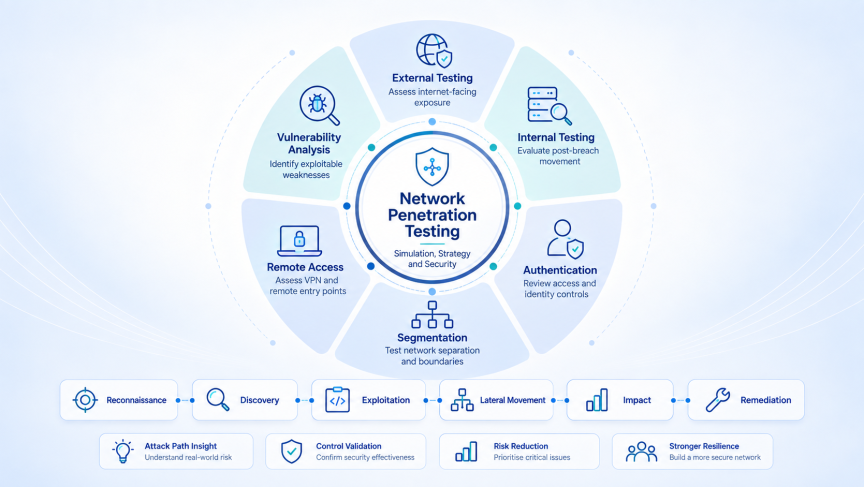
Network Penetration Testing is an authorised security assessment that simulates realistic attacks against network infrastructure to identify and validate exploitable weaknesses before malicious actors can use them.
Unlike vulnerability scanning alone, a penetration test combines automated tools with manual analysis, technical judgement and controlled exploitation. This allows organisations to understand not only which vulnerabilities exist, but also how they might be combined into realistic attack paths and what impact successful exploitation could have.
This article explains how network penetration testing works, the difference between external and internal assessments, the vulnerabilities commonly identified and how testing can support wider cyber security and assurance.
What Is Network Penetration Testing?
Network penetration testing is a controlled assessment of an organisation’s network infrastructure.
Qualified penetration testers use techniques similar to those used by real attackers, but operate within an agreed scope and with explicit authorisation.
A network penetration test may assess:
- Servers
- Firewalls
- Routers
- Switches
- Workstations
- Virtual private networks
- Remote-access services
- Network-management interfaces
- Authentication services
- Directory services
- Wireless infrastructure
- Cloud-connected network services
The objective is to identify weaknesses that could provide attackers with access to systems or information.
Testing may determine whether an attacker could:
- Gain initial access
- Bypass security controls
- Exploit vulnerable services
- Obtain credentials
- Increase privileges
- Move laterally between systems
- Access sensitive resources
- Reach critical infrastructure
- Avoid or delay detection
The results provide organisations with evidence of how their network would respond to realistic attack techniques.
Why Is Network Penetration Testing Important?
Networks rarely remain static.
New devices are introduced, employees change roles, cloud services are connected, firewall rules are modified and software is updated. Each change can alter the organisation’s attack surface.
A vulnerability that did not exist during a previous assessment may therefore appear later.
Network penetration testing helps organisations understand their exposure from an attacker’s perspective and determine whether security controls operate as expected.
It can also identify situations where several individually minor weaknesses combine to create a more serious attack path.
For example, an exposed service might initially appear low risk. However, if it allows an attacker to obtain credentials, access an internal system and then escalate privileges, the overall business impact could be significantly greater.
External Network Penetration Testing
An external network penetration test examines infrastructure that can be reached from outside the organisation.
The tester normally begins from the perspective of an attacker on the internet without legitimate internal access.
Targets may include:
- Public internet addresses
- Firewalls
- Remote-access gateways
- VPN services
- Email infrastructure
- Externally accessible servers
- Network-management interfaces
- Cloud-hosted infrastructure
- Exposed services and ports
The purpose is to determine what an external attacker could discover and exploit.
Testing may identify:
- Exposed administrative services
- Unsupported software
- Vulnerable network services
- Weak authentication
- Insecure protocols
- Unnecessary open ports
- Firewall misconfiguration
- Information leakage
- Remote-access weaknesses
An external assessment can provide useful insight into the organisation’s publicly visible attack surface.
Internal Network Penetration Testing
An internal network penetration test begins from within the organisation’s network or from an authenticated position.
This can simulate scenarios such as:
- A compromised employee account
- An infected workstation
- Stolen credentials
- A malicious insider
- A compromised supplier connection
- An attacker who has already bypassed the external perimeter
The tester assesses what an attacker could achieve after obtaining an initial foothold.
This may involve testing:
- Network segmentation
- Directory services
- User permissions
- Administrative privileges
- Authentication systems
- File shares
- Internal applications
- Remote-management services
- Trust relationships
- Credential security
Internal testing is particularly important because preventing every initial compromise is unrealistic.
Organisations should also understand what happens after an attacker gains access.
External and Internal Testing Together
External and internal assessments answer different security questions.
External testing asks:
Can an attacker get into the environment from the internet?
Internal testing asks:
If an attacker obtains access, how far can they go?
Using both can provide a more complete understanding of network risk.
For example, strong perimeter controls may prevent direct external compromise while weaknesses inside the network could still allow significant lateral movement if an employee account is compromised through phishing or credential theft.
Network Penetration Testing Methodology
A professional network penetration test should follow a structured process.
Although individual methodologies differ, most assessments include several common stages.
1. Scoping and Planning
Before testing begins, the organisation and penetration-testing provider define the rules of engagement.
This normally includes:
- Systems within scope
- Internet addresses
- Internal network ranges
- Testing objectives
- Permitted techniques
- Excluded systems
- Testing periods
- Escalation procedures
- Business-critical infrastructure
- Data-handling requirements
- Communication arrangements
- Reporting expectations
Testing must be explicitly authorised.
The scope should also consider operational risk. Some production systems may require additional precautions because aggressive testing could affect availability.
2. Reconnaissance and Network Discovery
The tester gathers information about the target environment.
Depending on the assessment, this may include identifying:
- Live hosts
- Internet addresses
- Open ports
- Network services
- Operating systems
- Domains
- Remote-access systems
- Network architecture
- Publicly available technical information
This helps build an understanding of the attack surface and identify areas requiring further investigation.
3. Vulnerability Assessment
The tester examines systems and services for potential weaknesses.
Automated tools may be used to identify possible vulnerabilities, but professional testing should also include manual validation and analysis.
Potential findings may include:
- Missing security updates
- Unsupported software
- Weak protocols
- Insecure configuration
- Exposed services
- Default credentials
- Weak authentication
- Excessive permissions
- Poor segmentation
- Vulnerable network services
Scanner results should not automatically be treated as confirmed vulnerabilities.
Manual investigation helps establish whether findings are genuine and whether they can be exploited in the particular environment.
4. Controlled Exploitation
Where authorised, testers attempt to exploit selected weaknesses.
The aim is to demonstrate what an attacker could realistically achieve without causing unnecessary disruption.
Successful exploitation may demonstrate:
- Unauthorised system access
- Credential compromise
- Access to restricted services
- Security-control bypass
- Increased privileges
- Exposure of sensitive information
Testing should remain proportionate to the agreed objectives.
The goal is to prove risk rather than cause damage.
5. Privilege Escalation
Initial access does not always provide an attacker with significant control.
The tester may therefore assess whether existing weaknesses allow privileges to be increased.
Examples may include:
- Excessive account permissions
- Weak administrative controls
- Insecure service accounts
- Credential reuse
- Misconfigured directory permissions
- Local privilege-escalation vulnerabilities
Privilege escalation can transform a limited compromise into a much more serious incident.
6. Lateral Movement
Once an attacker gains access to one system, they may attempt to move to other parts of the network.
This is known as lateral movement.
Testing may assess whether weaknesses allow access between:
- User workstations
- Servers
- Administrative systems
- File shares
- Network segments
- Cloud-connected resources
- Critical business systems
Effective network segmentation should restrict unnecessary movement between systems.
A penetration test can demonstrate whether those boundaries work in practice.
7. Impact Assessment
A vulnerability should not be assessed solely by its technical characteristics.
The tester should also consider what successful exploitation means for the organisation.
This may include the ability to:
- Access confidential information
- Control critical systems
- Compromise additional accounts
- Disrupt operations
- Reach backup infrastructure
- Modify information
- Interfere with security controls
Understanding business impact helps organisations prioritise remediation appropriately.
8. Reporting and Remediation
The final report should provide a clear record of the assessment.
This normally includes:
- Scope
- Testing methodology
- Limitations
- Confirmed vulnerabilities
- Exploitation evidence
- Attack paths
- Risk ratings
- Business impact
- Remediation recommendations
- Priority actions
Technical findings should be written clearly enough for IT and security teams to act on them.
Executive reporting should also explain the wider business significance of important findings.
9. Retesting
After remediation has been completed, targeted retesting can confirm whether vulnerabilities have been resolved successfully.
Retesting also helps establish whether changes have introduced additional weaknesses.
Common Network Security Weaknesses
Network penetration testing can uncover a wide range of vulnerabilities.
Some of the most common areas include the following.
Missing Security Updates
Unsupported or unpatched systems may contain publicly known vulnerabilities that attackers can exploit.
Patch management should therefore include:
- Operating systems
- Network appliances
- Servers
- Firmware
- Remote-access systems
- Security products
Weak Authentication
Authentication weaknesses can provide attackers with direct access to network resources.
Testing may identify:
- Weak passwords
- Default credentials
- Shared accounts
- Missing multi-factor authentication
- Credential reuse
- Insecure authentication protocols
Strong authentication is particularly important for administrative and remote-access systems.
Excessive Privileges
Users and service accounts may have greater permissions than they require.
If one of these accounts is compromised, excessive privileges can increase the attacker’s access.
The principle of least privilege should therefore be applied wherever practical.
Poor Network Segmentation
Flat networks can allow attackers to move relatively easily between systems.
Segmentation separates environments according to their function or sensitivity.
For example, organisations may separate:
- User devices
- Servers
- Guest networks
- Administrative systems
- Development environments
- Critical infrastructure
- Backup systems
Penetration testing can determine whether those boundaries actually restrict unauthorised movement.
Insecure Services and Protocols
Legacy protocols and unnecessary network services can create avoidable exposure.
Testing may identify:
- Unencrypted protocols
- Legacy authentication
- Exposed management interfaces
- Unnecessary services
- Weak remote-access configurations
Removing or restricting unnecessary services reduces the available attack surface.
Firewall and Access-Control Weaknesses
Firewall rules can become increasingly complex over time.
Old or overly permissive rules may remain after systems or business requirements change.
Testing can help identify:
- Unnecessary inbound access
- Excessive internal connectivity
- Exposed administrative interfaces
- Incorrect segmentation rules
- Weak restrictions between environments
Directory and Identity Weaknesses
Identity systems can become central attack targets because compromising them may provide access across large parts of the organisation.
Testing may assess:
- Privileged groups
- Service accounts
- Credential exposure
- Trust relationships
- Password policies
- Administrative paths
- Excessive permissions
The purpose is to determine whether a limited account can be turned into broader network access.
Remote Access and VPN Security
Remote working has increased organisational reliance on externally accessible authentication and connectivity services.
Testing may examine:
- VPN gateways
- Remote desktop services
- Administrative portals
- Multi-factor authentication
- Authentication policies
- Exposed management services
Remote-access infrastructure should be treated as a particularly important part of the external attack surface.
Network Penetration Testing Versus Vulnerability Scanning
Vulnerability scanning and penetration testing are related but serve different purposes.
A vulnerability scanner can efficiently examine many systems for known weaknesses.
It can provide useful coverage for:
- Missing patches
- Known vulnerabilities
- Open ports
- Outdated software
- Common configuration weaknesses
Penetration testing goes further.
A penetration tester can:
- Validate scanner findings
- Demonstrate exploitability
- Combine multiple weaknesses
- Test privilege escalation
- Explore lateral movement
- Assess business impact
- Apply contextual judgement
Vulnerability scanning is therefore useful for regular monitoring, while penetration testing provides deeper investigation of defined systems and attack scenarios.
The two activities should complement one another rather than be treated as replacements.
Supporting Compliance and Security Assurance
Network penetration testing can also support wider compliance and assurance activity.
UK organisations may need to demonstrate that appropriate security controls exist and are being tested effectively because of regulatory obligations, contracts, certification requirements or customer assurance processes.
Penetration-testing evidence may therefore support activities associated with areas such as:
- UK data-protection security responsibilities
- Cyber Essentials Plus and wider cyber hygiene
- ISO 27001
- PCI DSS
- Supplier assurance
- Customer security reviews
- Internal governance
However, completing a penetration test does not automatically make an organisation compliant with any particular standard or regulation.
The organisation remains responsible for understanding its applicable requirements and maintaining the wider controls required to meet them.
How Often Should Network Penetration Testing Be Performed?
There is no universal frequency suitable for every organisation.
A penetration test represents the condition of the environment at a particular point in time.
The appropriate frequency should therefore reflect:
- Business risk
- Infrastructure complexity
- Rate of technical change
- Exposure to threats
- Regulatory requirements
- Customer requirements
- Previous findings
Additional testing may be appropriate:
- After major network changes
- Following cloud migration
- After introducing new remote-access infrastructure
- Following significant firewall changes
- After a serious security incident
- When new critical systems are introduced
- When the organisation’s risk profile changes
Higher-risk environments may require more regular assessment.
Getting Greater Value From Network Penetration Testing
The value of a penetration test depends on what happens after the assessment.
Simply producing a report does not reduce risk.
Organisations should use findings to:
- Prioritise remediation
- Correct insecure configurations
- Improve segmentation
- Strengthen identity controls
- Remove unnecessary exposure
- Improve vulnerability management
- Review monitoring and detection
- Update security architecture
- Verify remediation through retesting
Patterns across multiple findings can also reveal wider control weaknesses.
For example, several privilege-related vulnerabilities may indicate that identity governance needs improvement rather than each issue being treated separately.
Improving Network Security Through Testing
Network penetration testing provides organisations with a controlled way to understand how attackers could exploit weaknesses across their infrastructure. External testing examines publicly exposed attack paths, while internal testing demonstrates what could happen after an attacker gains an initial foothold.
Effective testing should combine automated discovery with manual analysis, controlled exploitation and an assessment of realistic business impact. Findings should then be used to prioritise remediation, strengthen network architecture and verify that security controls operate effectively.
A penetration test should not be treated as a one-off guarantee of security. Networks continue to change as systems, users, suppliers and cloud services evolve. Testing should therefore form part of a wider programme that includes vulnerability management, secure configuration, monitoring, access control and regular review.
SeCore’s Penetration Testing services help organisations identify exploitable weaknesses across network environments, understand realistic attack paths and prioritise remediation according to business risk. By combining structured penetration testing with wider security assurance, organisations can gain clearer evidence of how effectively their network controls are reducing exposure.