Organisations are expected to protect increasing volumes of information across cloud services, applications, networks, suppliers and employees. Implementing individual security controls is important, but organisations also need a structured way to manage information security risk and demonstrate that their approach is consistent and repeatable.
ISO/IEC 27001, commonly referred to as ISO 27001, is an international standard for establishing, implementing, maintaining and continually improving an Information Security Management System.
Rather than prescribing one fixed set of technical controls for every organisation, ISO 27001 provides a risk-based framework for deciding what needs to be protected, which risks need to be addressed and how security controls should be managed over time.
For organisations seeking external assurance, ISO 27001 can also provide a route to independent certification.
What Is ISO 27001?
ISO 27001 is an international standard for information security management.
Its central concept is the Information Security Management System, or ISMS.
An ISMS provides a structured approach to managing:
- Information security risks
- Security policies
- Roles and responsibilities
- Security controls
- Risk treatment
- Internal audits
- Security objectives
- Management review
- Continual improvement
The standard is designed to be applicable to organisations of different sizes and sectors.
Rather than focusing only on technology, ISO 27001 considers the wider management system required to protect information effectively.
This includes people, processes, physical security and technology.
What Is an Information Security Management System?
An Information Security Management System is the framework an organisation uses to manage information security systematically.
It brings together:
- Governance
- Risk assessment
- Policies
- Security controls
- Evidence
- Responsibilities
- Monitoring
- Review
- Improvement
The ISMS should reflect the organisation’s actual business environment.
For example, an organisation handling sensitive customer information through cloud applications may have different security priorities from a manufacturer operating industrial systems.
The objective is therefore not to apply every possible security control.
It is to identify relevant risks, determine appropriate treatment and maintain evidence that those risks are being managed.
ISO 27001 and Risk Management
Risk management is central to ISO 27001.
Organisations need to establish a process for identifying and assessing information security risks.
This normally involves considering:
- Assets and information
- Threats
- Vulnerabilities
- Existing controls
- Likelihood
- Potential impact
The organisation can then determine whether each risk should be:
- Reduced
- Avoided
- Transferred
- Accepted
Where risks need to be reduced, appropriate security controls are selected and implemented.
This risk-based approach is important because the same security weakness can have very different consequences depending on the system, information and organisation involved.
The Main ISO 27001 Requirements
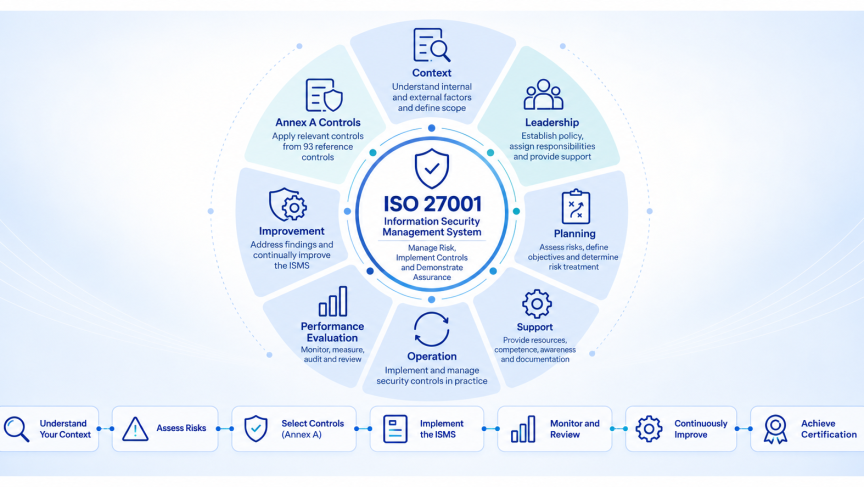
The management-system requirements of ISO 27001 are structured around several core areas.
Organisational Context
The organisation should understand the environment in which the ISMS operates.
This includes identifying:
- Relevant internal issues
- External factors
- Interested parties
- Information security requirements
- The scope of the ISMS
Defining scope correctly is particularly important.
Certification may cover the entire organisation or a defined part of it, depending on how the ISMS has been established.
Leadership
Senior management is expected to demonstrate responsibility for information security.
This includes establishing an information security policy, assigning responsibilities and ensuring security objectives support the organisation’s wider direction.
Information security should therefore not sit entirely within the IT department.
Effective implementation requires management ownership and appropriate resources.
Planning
Organisations need to assess information security risks and determine how those risks will be treated.
Security objectives should also be defined so that progress can be monitored.
Planning should consider both existing security risks and changes that could affect the ISMS.
Support
The ISMS needs appropriate resources, skills and documentation.
This includes areas such as:
- Staff competence
- Security awareness
- Communication
- Documented information
- Responsibilities
Security policies alone are not enough if the organisation cannot demonstrate that employees understand their responsibilities or that security processes operate consistently.
Operation
The organisation needs to carry out its risk assessment and risk-treatment processes in practice.
This includes implementing the controls and actions identified through the ISMS.
Changes to systems, suppliers, technologies or business processes may also require risks to be reassessed.
Performance Evaluation
An organisation must evaluate whether the ISMS is operating effectively.
Activities may include:
- Monitoring
- Measurement
- Internal audits
- Management reviews
- Assessment of security objectives
This creates evidence that the ISMS is being actively managed rather than existing only as documentation.
Improvement
Security weaknesses, audit findings and other nonconformities should lead to corrective action.
The organisation should identify causes, address problems and continually improve the ISMS.
This improvement cycle is one of the most important aspects of ISO 27001.
Certification is therefore not intended to represent a security position that remains unchanged indefinitely.
ISO 27001 Annex A Controls
ISO 27001 includes a reference set of security controls within Annex A.
The current structure contains 93 controls organised across four themes:
- Organisational controls
- People controls
- Physical controls
- Technological controls
These areas cover a wide range of information security concerns.
Examples include:
- Access control
- Identity management
- Security awareness
- Supplier security
- Asset management
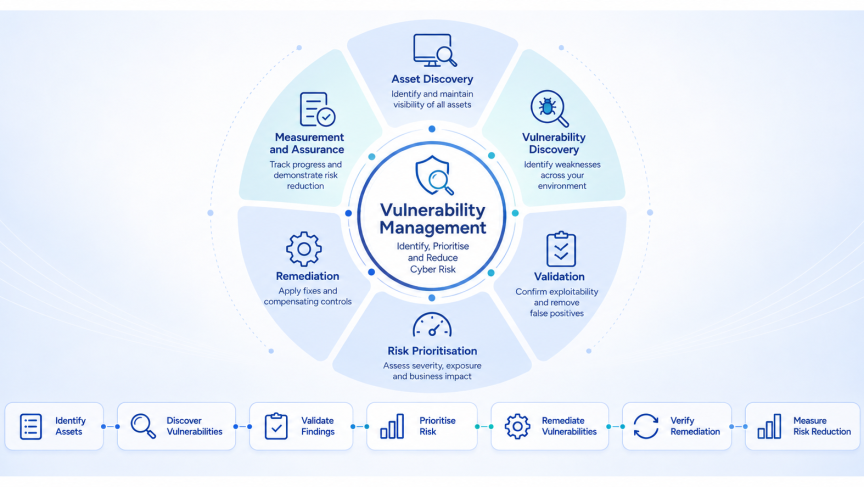
- Vulnerability management
- Logging and monitoring
- Backup
- Incident management
- Secure development
- Encryption
- Physical security
A common misunderstanding is that every organisation must implement all 93 controls.
That is not how ISO 27001 is intended to work.
Controls should be determined through the organisation’s risk-treatment process, with Annex A used as an important reference to ensure relevant areas have not been overlooked.
What Is the Statement of Applicability?
The Statement of Applicability, commonly abbreviated to SoA, is an important part of an ISO 27001 ISMS.
It records the controls considered relevant to the organisation and explains their status.
The Statement of Applicability should show:
- Which controls are necessary
- Whether they have been implemented
- Why particular controls are included
- Why Annex A controls have been excluded where applicable
The SoA therefore connects the organisation’s risk assessment with its chosen security controls.
It should reflect the actual security environment rather than being treated as a generic template.
ISO 27001 and ISO 27002
ISO 27001 and ISO 27002 are closely related but perform different roles.
ISO 27001 defines the requirements for an Information Security Management System and is the standard against which an organisation can be certified.
ISO 27002 provides more detailed guidance on information security controls.
Organisations implementing ISO 27001 can therefore use ISO 27002 to better understand how relevant controls may be applied.
ISO 27002 itself is not a replacement for the management-system requirements of ISO 27001.
What Does ISO 27001 Certification Mean?
ISO 27001 certification provides independent confirmation that an organisation’s ISMS has been assessed against the requirements of the standard.
Certification normally involves an independent certification body reviewing the organisation’s management system and evidence.
The process commonly includes an initial review of the ISMS followed by a more detailed assessment of implementation.
Once certified, organisations are subject to ongoing surveillance and periodic reassessment.
Certification therefore involves continuing to operate and maintain the ISMS rather than passing a one-time audit.
Choosing a Certification Body
UK organisations seeking certification should consider whether the certification body holds appropriate accreditation.
Accreditation provides additional assurance that the certification body itself has been assessed for competence and operates against recognised requirements.
Organisations should check:
- The certification body’s accreditation
- Whether its scope includes ISO 27001
- Whether the certificate can be independently verified
Certification from an appropriately accredited body can provide greater confidence to customers, procurement teams and other stakeholders.
ISO 27001 and Cyber Essentials
ISO 27001 and Cyber Essentials both support stronger cyber security, but they serve different purposes.
Cyber Essentials focuses on a defined set of technical controls intended to protect organisations against common cyber attacks.
ISO 27001 is a broader information security management standard built around risk management, governance, controls and continual improvement.
An organisation may therefore hold both.
Cyber Essentials can provide evidence of baseline technical security, while ISO 27001 demonstrates a wider management-system approach to information security.
Neither should be treated as a guarantee that every cyber risk has been eliminated.
ISO 27001 and Security Compliance
ISO 27001 can support wider security and compliance requirements by providing a structured framework for managing security controls and evidence.
Customers and procurement teams may also request ISO 27001 certification when assessing suppliers.
However, ISO 27001 is not a substitute for understanding specific regulatory or contractual obligations.
An organisation may still need to meet additional requirements relating to:
- Data protection
- Payment security
- Sector-specific regulation
- Customer contracts
- Government procurement
- Supplier requirements
The ISMS can provide a structured foundation for managing these overlapping responsibilities.
Common ISO 27001 Challenges
Treating Certification as the Only Objective
Organisations can become overly focused on passing an audit.
The real purpose of the ISMS should be to manage information security risk effectively.
Excessive Documentation
Documentation is important, but producing large numbers of policies does not necessarily improve security.
Evidence should support real processes and controls.
Weak Risk Assessments
If risks are poorly understood, the controls selected to address them may also be inappropriate.
Risk assessment should reflect the actual systems and business context.
Controls That Exist but Are Not Effective
A control may be documented without operating effectively.
For example:
- Access reviews may occur irregularly
- Vulnerabilities may remain unresolved
- Logs may be collected but not reviewed
- Incident-response plans may never be tested
Security assurance should therefore consider control effectiveness as well as control existence.
Failure to Keep the ISMS Current
Organisations change over time.
New systems, suppliers, employees, cloud platforms and threats can all affect the risk environment.
The ISMS needs to evolve with those changes.
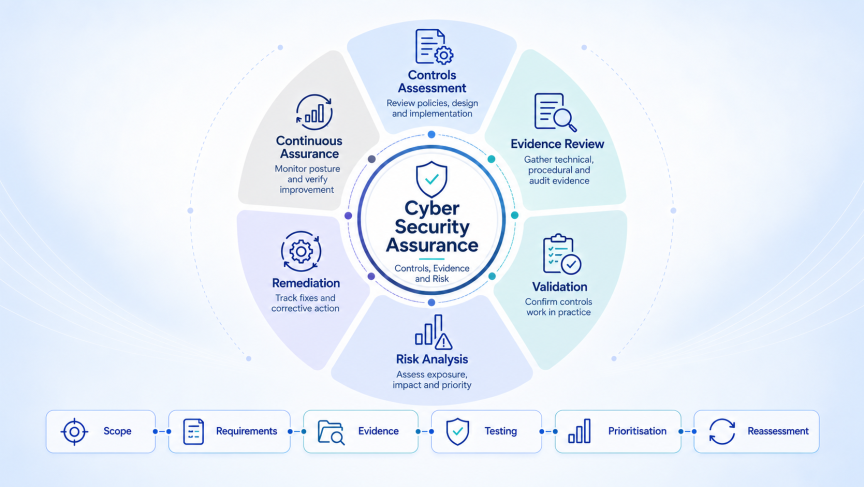
ISO 27001 and Security Assurance
ISO 27001 provides a strong framework for managing information security, but assurance should go beyond confirming that required processes exist.
Organisations should also understand whether controls are producing the intended security outcomes.
Technical validation may include:
- Vulnerability assessment
- Penetration testing
- Configuration review
- Access-control testing
- Evidence review
- Remediation verification
Combining management-system evidence with technical testing can provide greater confidence that security controls are operating effectively.
Building Stronger Assurance with ISO 27001
ISO 27001 provides organisations with a structured, risk-based approach to managing information security. By establishing an ISMS, assessing risks, selecting appropriate controls and continually reviewing performance, organisations can create a more consistent and accountable security programme.
Certification can provide valuable external assurance, but the greatest benefit comes from using the framework to understand and reduce genuine security risk rather than treating certification as the final objective.
Controls should remain aligned with changing systems, suppliers and threats, while significant weaknesses should be validated and remediation verified.
SeCore’s Security Assurance services help organisations assess security requirements, validate controls, structure evidence and prioritise remediation according to business risk. By combining standards-aligned assessment with technical evidence and quantitative security assurance, organisations can move beyond certification towards a clearer understanding of how effectively their security controls are reducing risk.