Organisations regularly introduce new applications, cloud services, devices and infrastructure into their environments. At the same time, vulnerabilities continue to emerge in technology that is already in use.
The challenge is therefore not simply finding vulnerabilities. Most organisations can generate lists of weaknesses through automated scanning. The more important challenge is understanding which vulnerabilities create meaningful risk, which should be addressed first and whether remediation has actually reduced the organisation’s exposure.
Vulnerability management is the structured process of identifying, assessing, prioritising, remediating and verifying security weaknesses across an organisation’s technology environment.
A strong vulnerability-management programme combines technical severity with factors such as exploitability, asset importance, exposure and potential business impact. This allows organisations to focus limited security resources on the weaknesses that matter most.
What Is Vulnerability Management?
Vulnerability management is an ongoing cyber security process for identifying and reducing weaknesses that attackers could exploit.
Vulnerabilities may exist within:
- Operating systems
- Applications
- Servers
- Endpoints
- Network devices
- Cloud environments
- APIs
- Containers
- Identity systems
- Security configurations
- Third-party software
A vulnerability-management programme should help an organisation answer several important questions:
- What vulnerabilities exist?
- Which assets are affected?
- Are those assets exposed to potential attackers?
- Is exploitation realistic?
- What access could an attacker gain?
- What would the business impact be?
- Which issues should be prioritised?
- Has remediation actually resolved the risk?
This makes vulnerability management more than a scanning exercise. It connects technical findings with wider cyber risk.
Why Vulnerability Management Matters
Technology environments change regularly.
A system that was secure during a previous assessment can become vulnerable because:
- A new vulnerability is disclosed
- A security update is missed
- A configuration is changed
- A cloud service is deployed incorrectly
- A new application becomes internet-facing
- User permissions are modified
- Unsupported technology remains in use
- A third-party component develops a security weakness
Without an organised process, vulnerabilities can remain unresolved for long periods or become lost among large numbers of lower-priority findings.
Effective vulnerability management gives organisations a repeatable way to identify weaknesses, understand their significance and track them through remediation.
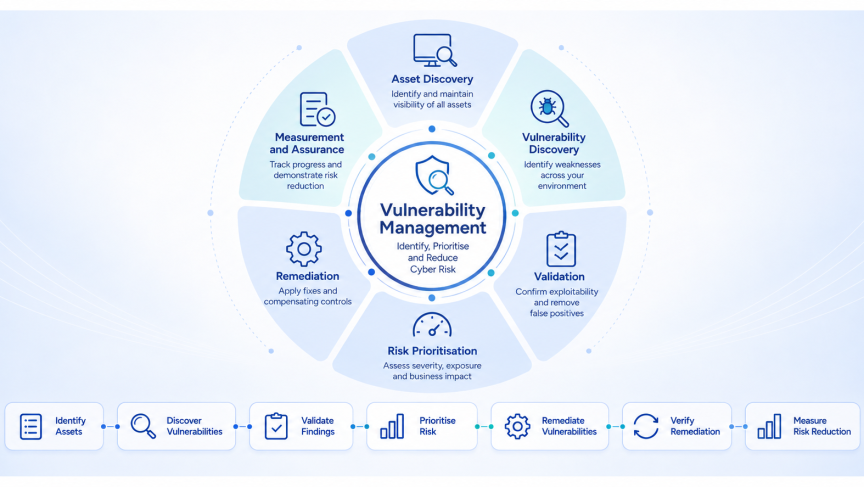
The Vulnerability Management Lifecycle
A practical vulnerability-management programme can be divided into several stages.
1. Identify Assets
Organisations first need to understand which systems they are responsible for.
An asset inventory may include:
- Servers
- Laptops and workstations
- Network infrastructure
- Applications
- Databases
- Cloud workloads
- Virtual machines
- Containers
- APIs
- Internet-facing services
Asset visibility is essential because technology that is not known or recorded may never be assessed.
This can create particular problems in cloud environments, where new resources can be deployed quickly and may remain outside established security processes.
2. Discover Vulnerabilities
Once assets are understood, organisations can assess them for weaknesses.
Automated vulnerability tools can identify issues such as:
- Missing security updates
- Known software vulnerabilities
- Unsupported software
- Exposed services
- Weak configurations
- Insecure protocols
- Publicly accessible resources
Other weaknesses may be identified through:
- Configuration reviews
- Cloud security assessments
- Penetration testing
- Security audits
- Application testing
- Supplier notifications
- Internal security investigations
The objective is to build accurate visibility of weaknesses across the environment.
3. Validate Findings
Not every vulnerability identified by an automated tool represents the same level of risk.
Scanners may produce false positives or identify technical weaknesses that cannot realistically be exploited in a particular environment.
Findings should therefore be reviewed where appropriate.
Validation may consider:
- Whether the vulnerable component is actually present
- Whether the affected service is accessible
- Whether exploitation requires authentication
- Which security controls are already in place
- Whether the affected system contains valuable information
- Whether an attacker could reach other systems from it
For high-risk vulnerabilities, manual analysis or penetration testing may provide stronger evidence of practical exploitability.
4. Prioritise Vulnerabilities
Prioritisation is one of the most important parts of vulnerability management.
Large environments can contain hundreds or thousands of findings. Attempting to remediate every vulnerability in severity order alone can waste time and resources.
Priority should consider factors such as:
- Technical severity
- Exploitability
- Internet exposure
- Known exploitation activity
- Availability of public exploit techniques
- Asset criticality
- Data sensitivity
- User privileges
- Network location
- Existing security controls
- Potential business impact
This creates a more realistic picture of risk.
Why Vulnerability Severity Alone Is Not Enough
Vulnerability ratings such as CVSS provide a useful standardised indication of technical severity.
However, technical severity and organisational risk are not the same thing.
Consider two organisations affected by the same vulnerability.
In one environment, the vulnerable system may be isolated, have no external connectivity and contain no important information.
In another, the same vulnerability may exist on an internet-facing system containing customer information and connected to critical infrastructure.
The technical vulnerability is identical.
The risk to the organisation is not.
This is why vulnerability-management programmes should combine technical scoring with business and environmental context.
Exploitability
One of the most important questions is whether attackers can realistically exploit the weakness.
Organisations should consider:
- Is the system reachable?
- Does exploitation require valid credentials?
- Is exploit code publicly available?
- Is the vulnerability known to be actively exploited?
- Are additional conditions required?
- Are existing controls likely to block the attack?
A technically serious vulnerability that cannot be reached may present less immediate risk than a moderately rated vulnerability being actively exploited against internet-facing systems.
Asset Criticality
The importance of the affected asset should also influence priority.
A vulnerability affecting a critical system may deserve greater attention because compromise could disrupt important business operations.
Asset context may include:
- Business function
- Information sensitivity
- Customer impact
- Financial importance
- Operational dependency
- Privileged access
- Connectivity to other systems
Understanding what the asset does helps translate technical findings into business risk.
Attack Paths
Vulnerabilities should not always be considered independently.
Attackers often combine several weaknesses.
For example, an attacker may:
- Exploit a publicly exposed service
- Obtain user credentials
- Access an internal system
- Escalate privileges
- Move to a more sensitive environment
Individually, some of these weaknesses may appear moderate.
Together, they may create a serious compromise path.
Attack-path analysis helps organisations understand how vulnerabilities interact rather than treating every finding as an isolated technical issue.
5. Remediate Vulnerabilities
Once a vulnerability has been prioritised, the organisation needs to determine the appropriate response.
Remediation may involve:
- Applying a security update
- Changing a configuration
- Removing vulnerable software
- Restricting network access
- Correcting permissions
- Disabling an unnecessary service
- Rotating exposed credentials
- Replacing unsupported technology
The appropriate response depends on the vulnerability and the affected system.
Compensating Controls
Immediate remediation is not always possible.
A critical application may depend on software that cannot be updated immediately, or a vendor may not yet have released a permanent fix.
In these situations, compensating controls may reduce exposure temporarily.
Examples include:
- Restricting external access
- Adding firewall rules
- Disabling vulnerable functionality
- Increasing monitoring
- Limiting user privileges
- Isolating the affected system
Compensating controls should not become a reason to ignore the underlying issue.
The residual risk should remain visible until permanent remediation has been completed.
6. Verify Remediation
One of the most common weaknesses in vulnerability-management programmes is assuming that a completed remediation task means the risk has disappeared.
Remediation should be verified.
This can involve:
- Rescanning the system
- Reviewing the updated configuration
- Confirming the patch version
- Retesting the vulnerability
- Repeating selected penetration-testing activity
- Confirming that the original attack path has been removed
Verification provides evidence that the action taken has actually reduced risk.
Vulnerability Scanning and Penetration Testing
Vulnerability scanning and penetration testing support vulnerability management in different ways.
Vulnerability scanning provides broad automated coverage and can regularly identify known weaknesses across large environments.
Penetration testing provides deeper investigation by validating whether selected vulnerabilities can be exploited and what an attacker could achieve.
Scanning is therefore valuable for visibility.
Penetration testing is valuable for validation and attack-path analysis.
Neither replaces the wider vulnerability-management process, which also requires prioritisation, remediation, ownership and verification.
Vulnerability Management in Cloud Environments
Cloud infrastructure introduces additional vulnerability-management challenges.
Weaknesses can result from:
- Excessive permissions
- Public storage
- Exposed credentials
- Insecure network rules
- Misconfigured services
- Vulnerable workloads
- Weak APIs
- Poor identity controls
- Unmanaged resources
Cloud resources can also change much more quickly than traditional infrastructure.
Vulnerability management should therefore consider identity and configuration alongside conventional software vulnerabilities.
Third-Party and Software Supply-Chain Vulnerabilities
Organisations increasingly depend on software, platforms and services provided by third parties.
A vulnerability within a supplier or software dependency can affect many organisations simultaneously.
Vulnerability-management processes should therefore consider:
- Third-party software
- Libraries and dependencies
- Cloud services
- Software suppliers
- Managed service providers
- Supplier vulnerability notifications
- Update processes
Organisations should understand where external dependencies exist and how quickly important supplier vulnerabilities can be identified and addressed.
Supporting Security Assurance
Vulnerability management can provide important evidence of how an organisation manages cyber risk.
A mature programme should be able to demonstrate:
- Which assets are being assessed
- Which vulnerabilities have been identified
- How findings are prioritised
- Who owns remediation
- Which risks remain outstanding
- Which compensating controls have been applied
- Whether remediation has been verified
This evidence can support broader security assurance and compliance requirements.
However, producing vulnerability reports is not the same as demonstrating effective risk management.
The important question is whether the organisation is actually reducing exposure.
Measuring Vulnerability Management Effectiveness
Counting the total number of vulnerabilities can be misleading.
A large number of low-risk findings may be less important than a small number of exploitable weaknesses affecting critical systems.
More meaningful measures can include:
- Number of critical and high-risk vulnerabilities
- Time taken to remediate high-risk findings
- Internet-facing vulnerabilities
- Actively exploited vulnerabilities
- Outstanding risks beyond agreed remediation periods
- Recurring vulnerabilities
- Remediation verification rates
- Critical assets with unresolved weaknesses
- Changes in overall risk exposure
Metrics should help decision-makers understand whether risk is improving rather than simply showing how much scanning activity has taken place.
Common Vulnerability Management Challenges
Too Many Findings
Security teams can become overwhelmed by large vulnerability queues.
Risk-based prioritisation helps focus effort on the issues most likely to create meaningful impact.
Poor Asset Visibility
Unknown or unmanaged assets may never be assessed.
Maintaining accurate asset information is therefore fundamental.
Lack of Business Context
Technical teams may understand vulnerability severity without knowing how important the affected system is to the organisation.
Combining technical and business context improves prioritisation.
Slow Remediation
Finding vulnerabilities provides little benefit if serious weaknesses remain unresolved.
Clear ownership and remediation processes are essential.
No Verification
Issues may be marked as completed without confirming that the vulnerability has actually disappeared.
Verification closes the vulnerability-management lifecycle.
Turning Vulnerabilities Into Measurable Risk Reduction
Vulnerability management should give organisations more than a list of technical weaknesses. It should provide a structured way to understand which vulnerabilities matter most, why they matter and what action will meaningfully reduce exposure.
The strongest programmes combine automated discovery with contextual risk assessment, manual validation and targeted penetration testing. Technical severity should be considered alongside exploitability, asset criticality, exposure and potential business impact so that remediation resources are directed towards the most significant risks.
Remediation should also be verified rather than assumed successful. This creates stronger evidence that security action has translated into genuine risk reduction.
SeCore’s Security Assurance services help organisations identify security gaps, quantify cyber risk and prioritise remediation according to business impact. By connecting vulnerability findings with control evidence and wider security assurance, organisations can move beyond vulnerability lists towards a clearer, measurable understanding of where risk exists and how effectively it is being reduced.