Organisations invest in security controls, policies, testing and technology to reduce cyber risk. The challenge is proving whether those measures are actually working.
A firewall may be configured. Multi-factor authentication may be enabled. A penetration test may have been completed. Policies may exist. But none of these activities, viewed individually, necessarily shows how effectively an organisation is protected.
Cyber security assurance provides a structured way to assess security controls, examine supporting evidence and determine whether security measures are delivering the intended outcomes.
Rather than asking only whether a control exists, security assurance asks whether it is appropriate, implemented effectively and capable of reducing the risks it was designed to address.
What Is Cyber Security Assurance?
Cyber security assurance is the process of evaluating whether an organisation’s security controls and practices provide sufficient confidence that cyber risks are being managed effectively.
It brings together information from areas such as:
- Security controls
- Risk assessments
- Vulnerability findings
- Penetration testing
- Security configurations
- Policies and procedures
- Technical evidence
- Supplier assessments
- Remediation activity
The objective is not simply to collect security information.
The information needs to be assessed in context so organisations can understand:
- Which controls are operating effectively
- Where weaknesses remain
- Which risks require attention
- Whether remediation has improved security
- What evidence supports the assessment
This helps turn security activity into something that can be understood and acted upon.
Security, Compliance and Assurance
Security, compliance and assurance are closely related, but they answer different questions.
Cyber security asks:
What do we need to protect, and how should we protect it?
Compliance asks:
Which requirements must we meet?
Security assurance asks:
Do we have sufficient evidence that our controls are actually working?
An organisation can therefore meet a compliance requirement without necessarily demonstrating that every relevant security control is effective.
For example, a policy may require multi-factor authentication. Compliance may confirm that the policy exists and MFA has been implemented.
Security assurance goes further by examining questions such as:
- Which systems are actually protected by MFA?
- Are privileged accounts covered?
- Are exceptions being managed?
- Could authentication controls be bypassed?
- Is there evidence that the control remains effective?
The focus shifts from the existence of a requirement to the effectiveness of the security outcome.
Why Security Evidence Matters
Security decisions should be supported by evidence rather than assumptions.
Evidence can come from many sources, including:
- Configuration records
- Security test results
- Vulnerability scans
- Penetration-testing findings
- Access reviews
- Audit logs
- Security policies
- Risk assessments
- Monitoring information
- Remediation records
Different evidence provides different levels of confidence.
A written policy shows what an organisation intends to do.
A configuration record may show that a control has been implemented.
A penetration test may demonstrate whether the control can be bypassed.
Retesting after remediation may provide evidence that a weakness has been corrected.
Strong assurance therefore considers both documented controls and technical validation.
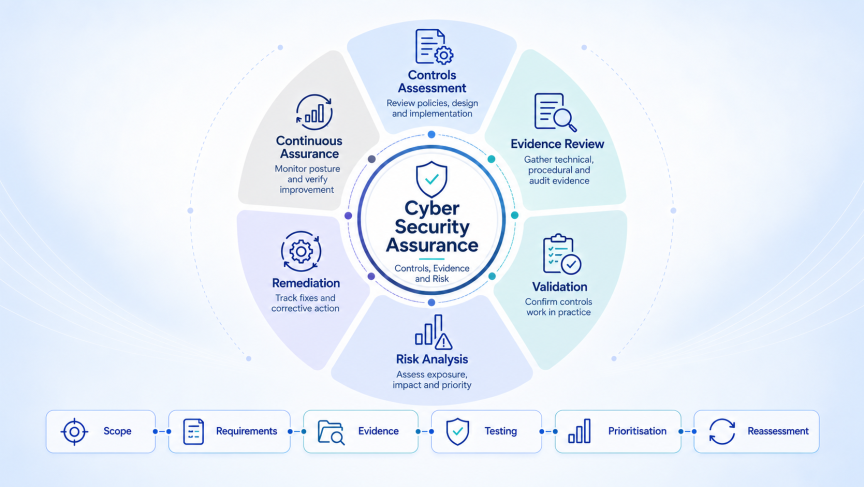
The Cyber Security Assurance Lifecycle
Effective security assurance is not a single assessment.
It is a repeatable process for understanding security posture, prioritising action and verifying improvement.
1. Define the Scope
The first step is identifying what is being assessed.
The scope may include:
- A business system
- An application
- A network
- Cloud infrastructure
- A supplier
- A service
- An organisational environment
The organisation should also understand why the assessment is being performed.
This may be to:
- Understand cyber risk
- Support customer assurance
- Assess readiness against a standard
- Prepare for procurement
- Evaluate a critical system
- Prioritise security investment
Clear scope prevents assessments from producing generic findings that are difficult to act upon.
2. Identify Relevant Security Requirements
The next step is defining what good security should look like for the environment being assessed.
Requirements may come from:
- Recognised security standards
- Regulatory obligations
- Customer requirements
- Internal policies
- Contractual commitments
- Security architecture
- Business risk
Not every system requires the same controls.
A public-facing application processing sensitive information may require stronger controls than a low-risk internal system.
Security requirements should therefore reflect the context and importance of the environment.
3. Gather Evidence
Evidence is then collected to determine how the organisation is meeting those requirements.
This may include:
- Technical configurations
- Security documentation
- Vulnerability findings
- Test results
- Access-control evidence
- Monitoring information
- Supplier information
- Existing certifications
The quality of an assurance assessment depends heavily on the quality of the evidence supporting it.
Self-attestation can provide useful information, but higher-risk controls may benefit from independent or technical validation.
4. Validate Security Controls
The next question is whether the control works as intended.
Validation methods may include:
- Configuration review
- Vulnerability assessment
- Penetration testing
- Evidence review
- Access testing
- Security-control testing
- Interviews with responsible teams
For example, an organisation may state that network segmentation protects a critical environment.
Security testing can help demonstrate whether those boundaries actually prevent unauthorised access.
This distinction between control existence and control effectiveness is central to meaningful security assurance.
5. Assess Risk
Security findings need to be considered within their business context.
A weakness becomes more important when it affects:
- Critical systems
- Sensitive information
- Privileged accounts
- Internet-facing services
- Important business operations
- Systems connected to other high-value assets
Assessment should therefore consider both technical severity and potential business impact.
This allows organisations to avoid treating every security finding as equally important.
6. Prioritise Remediation
Once gaps have been identified, organisations need to decide what to address first.
Prioritisation may consider:
- Risk severity
- Exploitability
- Asset importance
- Exposure
- Dependencies
- Remediation effort
- Potential improvement
The objective is to direct limited security resources towards actions that produce meaningful risk reduction.
This is particularly important in larger environments where resolving every identified issue immediately may not be practical.
7. Reassess and Verify
Remediation should not be treated as complete simply because an action has been recorded as finished.
Important changes should be verified.
This may involve:
- Reviewing a configuration
- Rescanning an asset
- Repeating a security test
- Retesting a vulnerability
- Reviewing updated evidence
The organisation can then compare the updated position with the previous assessment.
This provides evidence not only that work has been carried out, but that security has actually improved.
From Qualitative to Quantitative Security Assurance
Many traditional security assessments rely heavily on qualitative descriptions such as:
- Low risk
- Medium risk
- High risk
- Partially compliant
- Mostly implemented
These descriptions can be useful, but they can also make comparison and prioritisation difficult.
A quantitative approach attempts to translate security evidence and risk factors into more measurable outcomes.
This can help organisations compare:
- Different systems
- Security controls
- Suppliers
- Remediation options
- Changes in posture over time
Quantification should not replace professional judgement.
Its purpose is to make security information easier to interpret, compare and communicate.
Measuring More Than Vulnerabilities
Security assurance should not be reduced to vulnerability scanning.
Vulnerabilities are one important source of evidence, but an organisation’s overall security position also depends on factors such as:
- Identity and access controls
- Configuration
- Monitoring
- Incident response
- Supplier security
- Backup and recovery
- Governance
- Security testing
An environment with few known vulnerabilities may still have serious weaknesses if privileged access is poorly controlled or security monitoring is ineffective.
Assurance therefore needs to combine different evidence sources.
Security Assurance and Penetration Testing
Penetration testing can provide particularly strong evidence because it attempts to demonstrate whether security weaknesses can actually be exploited.
It can help validate:
- Network controls
- Authentication
- Application security
- Cloud configuration
- Privilege boundaries
- Segmentation
However, penetration testing remains a point-in-time assessment.
Security assurance places those findings within a broader picture that includes controls, business context, remediation and subsequent verification.
The two activities therefore complement one another.
Supporting Customer and Supplier Assurance
Organisations are increasingly asked to demonstrate their security posture to customers and business partners.
Requests may include:
- Security questionnaires
- Certification evidence
- Policies
- Testing reports
- Control evidence
- Supplier assessments
- Remediation information
A structured assurance process can make this evidence easier to organise and communicate.
It can also help organisations assess their own suppliers more consistently.
Rather than relying only on whether a supplier has completed a questionnaire, organisations can consider the strength of the evidence supporting their security claims.
Better Security Decisions
One of the most important purposes of assurance is improving decision-making.
Security teams frequently need to decide:
- Which vulnerability should be fixed first?
- Which system represents the greatest risk?
- Which supplier requires additional assurance?
- Which security improvement provides the greatest benefit?
- Has remediation materially changed the organisation’s position?
Assurance connects security evidence with these decisions.
This helps organisations move away from simply recording findings towards understanding what action will provide the greatest improvement.
Reporting Security Assurance to Leadership
Technical security information is not always easy for senior decision-makers to interpret.
Executives typically need to understand:
- Where significant risks exist
- Which systems require attention
- What remediation is underway
- Whether risk is improving
- Where additional investment may be needed
Effective assurance reporting should therefore translate technical findings into clear security and business context.
The objective is not to remove technical detail, but to present it in a form that supports decision-making.
Regular Reassessment
Security assurance should not stop after an assessment has been completed.
Technology environments continue to change.
Organisations introduce:
- New applications
- New suppliers
- Cloud services
- Employees
- Infrastructure changes
- Software updates
New vulnerabilities also emerge.
Regular reassessment allows organisations to determine whether their previous assurance remains valid and whether security controls have changed.
Turning Security Evidence Into Measurable Assurance
Cyber security assurance helps organisations move beyond simply implementing security controls towards understanding whether those controls are genuinely effective.
Strong assurance combines requirements, technical evidence, security testing and business context. It identifies gaps, prioritises remediation and verifies whether improvements have materially reduced risk.
The objective is not to create another security checklist. It is to provide clearer evidence of security posture and support better decisions about where organisations should act next.
SeCore’s Security Assurance services combine structured control assessment, technical evidence and quantitative cyber risk analysis to help organisations understand their security position and prioritise improvement. By connecting requirements, testing, scoring and remediation, organisations can move from fragmented security information towards clearer, evidence-backed assurance.